

Chicago Booth MBA Guide 2026–27: Admissions, Class Profile, Curriculum, Employment, Fees & Scholarships
A detailed guide to the Chicago Booth MBA covering the Class of 2027 profile, curriculum, GMAT and GRE scores, 2026–27 admissions, Class of 2025 career outcomes, costs, scholarships, and what the latest data means for applicants.
Chicago Booth is often described as the flexible, analytical MBA of the M7. That description is broadly accurate, but it can also hide what makes the program distinctive.
Booth does not give students complete freedom to avoid the fundamentals. Instead, it gives them considerable freedom to decide how deeply and at what level they study those fundamentals, then leaves substantial room for electives, concentrations, experiential learning, and courses elsewhere at the University of Chicago.
That difference matters.
For a candidate who already has strong finance training, Booth's flexibility can prevent the MBA from becoming a repetition of material they already know. For someone moving from engineering, public service, healthcare, or another non-business background, the same curriculum can be used to build a much broader management foundation.
The useful question is therefore not simply:
"Is Booth flexible?"
It is:
"Would I use that flexibility to build a coherent path toward the career and leadership capabilities I actually need?"
This guide examines the Full-Time MBA through that lens, using Booth's latest Class of 2027 profile, the Class of 2025 employment report, the 2026–27 admissions cycle, and the school's current cost and financial-aid information.
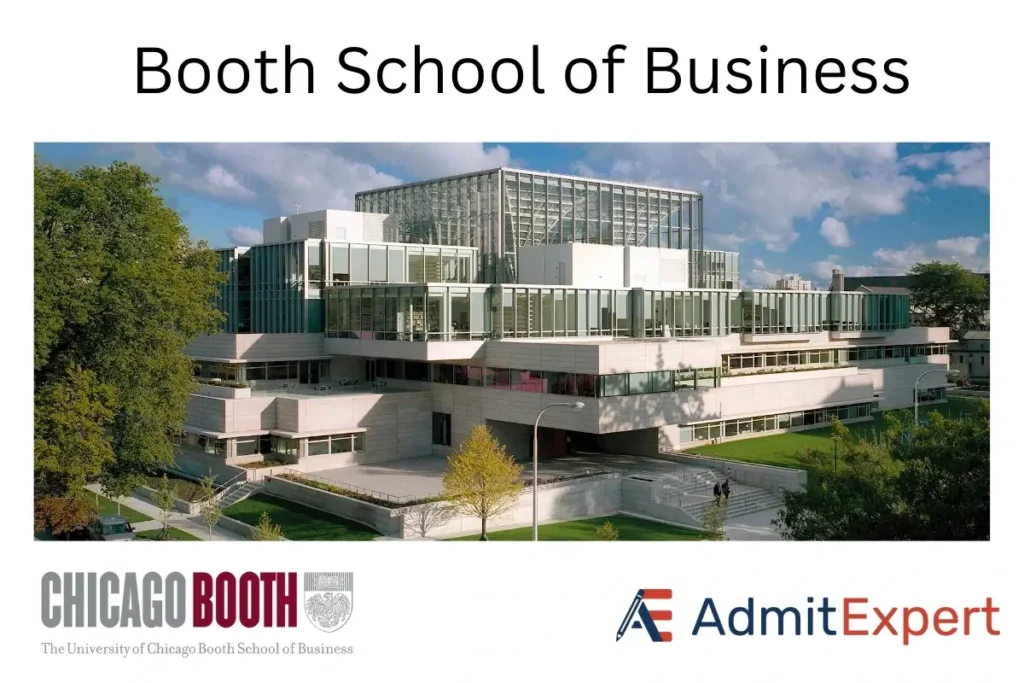
Chicago Booth MBA at a Glance
| Metric | Latest figure |
|---|---|
| Full-Time MBA Class of 2027 | 635 students |
| Applications submitted | 5,876 |
| Joint-degree students reported separately | 60 |
| Women | 41% |
| International students | 37% |
| Countries represented | 63 |
| Average work experience | 5 years |
| Average GPA | 3.6 |
| Current GMAT average / median | 670 / 675 |
| Legacy GMAT average / median | 736 / 740 |
| Average GRE | 161 Verbal / 163 Quantitative |
| Full-Time MBA length | 21 months |
| MBA concentrations | 16 |
| Class of 2025 median base salary | $175,000 |
| Job seekers receiving an offer within 3 months | 89.1% |
| 2026–27 tuition | $89,976 |
| 2026–27 first-year cost of attendance | $132,449 |
| STEM designation | Yes |
The latest Chicago Booth Class of 2027 profile reports 635 Full-Time MBA students and 5,876 applications. Booth also lists 60 joint-degree students separately on the profile.
One number the profile does not provide is an acceptance rate.
Dividing enrolled students by applications would produce an enrollment-to-application ratio, not an acceptance rate, because the number of admission offers is missing. Applicants should therefore avoid treating 635 ÷ 5,876 as Booth's admit rate.
What Makes the Chicago Booth MBA Different?
The most important academic difference at Booth is not that students can take whatever they want.
It is that Booth has structured requirements with unusually broad choice inside them.
The current MBA curriculum combines:
- LEAD, Booth's required experiential leadership program;
- three foundation areas;
- seven courses across functions, leadership and management, and the business environment;
- ten electives;
- and a qualified work-experience requirement for Full-Time MBA students.
That gives students both breadth and room to customize.
LEAD is the only universally required course component
Booth describes LEAD as the only required component of the MBA curriculum.
LEAD focuses on areas such as:
- negotiation,
- team building,
- interpersonal communication,
- self-awareness,
- and leadership effectiveness.
This matters because Booth's reputation for analytical rigor can lead applicants to imagine a program built almost entirely around quantitative decision-making.
The academic structure says otherwise.
Students can customize much of the curriculum, but leadership development begins with a shared experiential requirement. The MBA is designed to develop how students work with people as well as how they analyze business problems.
The three foundations can be basic or advanced
Booth requires students to cover three foundation areas:
- financial accounting;
- microeconomics;
- statistics.
But students do not necessarily take the same introductory course.
A candidate with substantial prior preparation can choose from approved advanced alternatives. In statistics, for example, Booth lists options ranging from Business Statistics to courses such as Machine Learning, Financial Econometrics, Data Intelligence, and other advanced substitutes.
That is one of the most important forms of flexibility in the program.
An experienced investor does not have to spend scarce MBA course capacity repeating basic material simply because another student needs it. At the same time, someone without formal business training can build the fundamentals before moving into more advanced work.
Seven distribution courses preserve breadth
After the foundations, students choose one course from seven of eight categories covering:
- finance,
- marketing,
- operations,
- strategy,
- decisions,
- people,
- economy,
- society.
This is why saying "Booth has no core" is misleading.
Booth has breadth requirements. What it does not have is a single prescribed sequence in which every student takes exactly the same version of each subject.
The distinction is important for applicants comparing Booth with more structured programs among the M7 business schools.
Ten electives create the real customization
Booth students then have 10 electives, and the school allows up to six courses outside Booth within the degree rules.
Students can use those electives to go deeper into a particular field, build one or more concentrations, explore the wider University of Chicago, or combine several disciplines.
Booth currently offers more than 100 elective MBA classes and 16 concentrations. The school's concentration system includes areas such as:
- Analytic Finance,
- Behavioral Science,
- Business Analytics,
- Econometrics and Statistics,
- Entrepreneurship,
- Finance,
- General Management,
- Healthcare,
- International Business,
- Marketing Management,
- Operations Management,
- Strategic Management,
- and other fields.
Concentrations are optional.
That is important because an MBA applicant should not approach Booth by asking, "Which concentration should I declare?" before understanding the career problem they are trying to solve.
The more useful sequence is:
Target role → capability gaps → courses and experiences → concentration, if useful.
Flexibility is valuable only when it is used deliberately
Booth's curriculum rewards self-direction.
A future private-equity investor could use electives to deepen industry knowledge, negotiation ability, operating judgment, and investment analysis. A product manager might combine technology strategy, marketing, data, organizational behavior, and experimentation. A future general manager might deliberately choose courses outside their strongest function.
The danger is the opposite: selecting courses because they sound interesting without building a coherent development plan.
A flexible curriculum creates options. It does not automatically create direction.
Experiential Learning at Booth
Booth's academic experience extends well beyond classroom courses.
Its current experiential-learning portfolio includes opportunities such as:
- the Private Equity/Venture Capital Lab,
- Healthcare Analytics Lab,
- Entrepreneurial Discovery,
- social-impact practicums,
- leadership labs,
- real-estate projects,
- AI-related applied courses,
- and the New Venture Challenge.
Why experiential learning matters for a career switch
For a career changer, an experiential course can do something a conventional class cannot: create recent evidence that you can operate in the field you are trying to enter.
Someone moving into private equity, for example, can study valuation in a classroom. Booth's PE/VC Lab adds exposure to real investment work and practitioners.
Someone pursuing entrepreneurship can learn frameworks in class. The New Venture Challenge forces teams to test an actual business concept, confront weak assumptions, and build toward execution.
That evidence can become useful in recruiting because it changes the conversation from:
"I am interested in this field."
to:
"Here is what I have already done to test whether I can succeed in it."
Chicago Booth MBA Class Profile 2027
The latest Class of 2027 profile shows a large, professionally diverse cohort.
Class Composition
| Metric | Class of 2027 |
|---|---|
| Full-Time MBA students | 635 |
| Applications | 5,876 |
| Women | 41% |
| International students | 37% |
| Countries represented | 63 |
| First-generation students | 12% |
| Undergraduate institutions represented | 286 |
| Students holding graduate-level degrees | 15% |
| Average work experience | 5 years |
| Average GPA | 3.6 |
| Reported GPA range | 2.5–4.0 |
The class is smaller than the prior cohort
Booth's Class of 2026 contained 714 students, while the Class of 2027 profile reports 635.
That brings the cohort much closer to Booth's earlier class sizes rather than continuing the unusually large Class of 2026.
For applicants, class size matters less as an admissions shortcut than as an experience question.
A 600-plus-student class creates:
- a large peer network,
- substantial club and recruiting communities,
- more potential classmates across industries,
- and a broad elective ecosystem.
It also means the experience is not naturally intimate by default. Students create smaller communities through cohorts, classes, clubs, recruiting groups, social circles, and experiential teams.
International representation remains substantial
International students make up 37% of the Class of 2027 and the class represents 63 countries.
That gives Booth a meaningfully international classroom, but international applicants should still separate classroom diversity from post-MBA work authorization and employer sponsorship.
Those are different questions.
Undergraduate Backgrounds
| Undergraduate field | Share |
|---|---|
| Business | 26% |
| Economics | 24% |
| Engineering | 21% |
| Liberal Arts | 13% |
| Physical Sciences | 9% |
| Law | 2% |
| Other | 5% |
Half of the class comes from business or economics backgrounds.
At the same time, engineering, physical sciences, liberal arts, law, and other fields collectively make up the other half.
That balance helps explain why Booth's flexible foundation system is useful. Students enter with very different levels of prior exposure to accounting, economics, statistics, organizations, and business functions.
A business graduate may use advanced alternatives to avoid repeating familiar material. An engineer may want more exposure to customers, organizations, and markets. A liberal-arts graduate may prioritize quantitative preparation.
The curriculum can start each of those students from a different point without abandoning common management breadth.
Pre-MBA Industry Background
| Pre-MBA industry | Share |
|---|---|
| Consulting | 23% |
| Financial services | 22% |
| Nonprofit / government | 12% |
| Technology | 10% |
| Private equity / venture capital | 8% |
| Healthcare | 5% |
| Consumer products | 3% |
| Energy | 3% |
| Manufacturing | 2% |
| Sports / media / entertainment | 2% |
| Real estate | 1% |
| Retail | 1% |
| Other | 7% |
Two observations stand out.
First, consulting, financial services, and PE/VC together account for 53% of the class. Applicants from those sectors are entering very well represented peer groups.
That means a prestigious consulting firm, bank, or investment fund can establish credibility, but employer brand alone is unlikely to differentiate an applicant. Admissions still needs to understand what you personally changed, led, built, decided, or learned.
Second, nonprofit and government backgrounds account for 12%, making that category larger than technology at 10%.
That is a useful counterweight to the stereotype that Booth primarily assembles finance and consulting professionals. The class is commercially strong, but the professional mix is broader than the school's finance reputation might suggest.
Chicago Booth GMAT, GRE, and GPA
Booth currently reports both the current GMAT and the legacy GMAT, which use different scoring scales.
Current GMAT
| Metric | Class of 2027 |
|---|---|
| Average | 670 |
| Median | 675 |
| Middle 80% | 615–725 |
Legacy GMAT
| Metric | Class of 2027 |
|---|---|
| Average | 736 |
| Median | 740 |
| Middle 80% | 690–770 |
GRE
| Metric | Class of 2027 |
|---|---|
| Average Verbal | 161 |
| Average Quantitative | 163 |
| Middle 80% Verbal | 155–167 |
| Middle 80% Quantitative | 156–169 |
GPA
The average GPA is 3.6, while Booth reports a range from 2.5 to 4.0 for U.S.-institution GPAs on the 4.0 scale.
What should applicants do with these numbers?
Do not convert the median into an unofficial cutoff.
Booth's admission requirements explicitly state that there is no minimum GMAT or GRE score for consideration.
The middle-80% ranges are useful because they show that enrolled students are not compressed around one number.
A score below the average may still be credible if the rest of the academic record is strong. A score above the average does not compensate for weak professional impact, unclear goals, poor recommendations, or an application that gives Booth little reason to believe you will contribute to the community.
The better test question is:
What academic evidence does my particular profile need?
For a candidate with strong quantitative grades and analytical work, the test may simply confirm readiness. For someone with a weak undergraduate record or little quantitative coursework, the test can play a more important role in reducing academic uncertainty.
And current-GMAT scores should never be compared numerically with old 730+ advice as if the scales were identical.
How Competitive Is Chicago Booth?
The class profile shows a highly selective applicant pool, but the available public data does not support a valid acceptance-rate calculation.
Booth reports:
- 5,876 applications;
- 635 Full-Time MBA students;
- a 3.6 average GPA;
- a 675 current-GMAT median;
- and approximately five years of work experience.
Those numbers describe the enrolled class. They do not tell you how many applicants received offers.
More importantly, Booth says its evaluation considers three broad areas: curriculum, community, and career.
That is a more useful admissions framework than attempting to reverse-engineer one score.
An effective Booth application needs to make three things credible:
- You can handle the academic environment.
- You will contribute meaningfully to the Booth community.
- Your career plan is coherent enough to explain why the MBA is necessary now.
Chicago Booth MBA Application Requirements
The current Full-Time MBA application is unusually concise on the written side.
Most applicants submit:
- the online application;
- four required short responses;
- a professional resume;
- one recommendation;
- academic transcripts;
- a GMAT or GRE score, subject to Booth's stated exceptions;
- any required English-language test;
- and the $250 application fee.
The four required responses are only 300 characters each
This is the most striking part of Booth's current written application.
Each of the four required responses has a 300-character limit, not a 300-word limit.
The prompts cover:
- immediate post-MBA career goals;
- long-term post-MBA career goals;
- the significance of an uploaded image;
- and a fun fact or something unique about the applicant.
The optional explanation section has a separate 300-word maximum.
Why 300 characters changes the application strategy
Three hundred characters is extremely little space.
You cannot spend half the response building context before reaching the point. Every answer needs to establish the essential information quickly.
For the career goals, specificity matters more than elaborate prose.
A useful immediate-goal response usually needs to make the function, industry, and direction understandable. The long-term response should then show where that first step is intended to lead.
The image and personal response have a different job. They give Booth a chance to see something beyond the resume and career plan.
Do not use those prompts to repeat achievements already obvious elsewhere in the application.
The strongest use of limited personal space is often to reveal:
- motivation,
- identity,
- curiosity,
- relationships,
- interests,
- humor,
- or a perspective that changes how the admissions reader understands you.
Our Chicago Booth MBA essay and application analysis goes deeper into how to approach the current prompts.
Booth requires one recommendation
Booth currently asks for one recommendation, preferably from a current supervisor when possible.
The school explicitly emphasizes substance over recommender status.
That makes recommender selection relatively straightforward: choose the person who can provide the strongest evidence of how you perform, where you have grown, how you compare with relevant peers, and how you respond to feedback.
A famous senior executive who barely knows your work is usually less useful than a manager who can describe specific decisions and behavior.
Interview plus video simulation
Booth interviews are invitation-only and virtual. An interview is required for admission.
Invited candidates also complete a brief video simulation exercise that is recorded and added to the application.
That means Booth evaluates communication in three different ways:
- extremely compressed written responses;
- a live virtual interview;
- and recorded video responses.
Applicants therefore need consistency across all three.
Your written application can be highly edited. The interview and video component make it harder to hide unclear motivation, weak self-awareness, or a career story you do not fully believe yourself.
Prepare examples around leadership, conflict, decisions, teamwork, failure, persuasion, and career motivation—but learn the stories rather than memorizing scripts.
Chicago Booth MBA Application Deadlines 2026–27
| Round | Application deadline | Decision notification |
|---|---|---|
| Round 1 | September 15, 2026 | December 3, 2026 |
| Round 2 | January 7, 2027 | March 25, 2027 |
| Round 3 | April 1, 2027 | May 20, 2027 |
| Chicago Booth Scholars | April 1, 2027 | June 24, 2027 |
Applications are due by 11:59 p.m. U.S. Central Time.
As of September 28, 2026, Round 1 has passed. The next regular Full-Time MBA deadline is therefore Round 2 on January 7, 2027.
The current dates are published on Booth's Full-Time MBA application page.
Is Round 2 too late for Booth?
No.
Round 2 is a normal admissions round. The more useful question is whether waiting until January will allow you to submit a materially stronger application.
That extra time may be valuable if you can:
- improve a test score;
- clarify the career transition;
- strengthen your school research;
- give your recommender better preparation time;
- or develop more precise short responses.
Round 3 should be treated differently because fewer seats remain and international applicants have less time for immigration logistics.
Chicago Booth Scholars is not Round 4
The Chicago Booth Scholars Program is Booth's deferred-admission route for students applying before beginning their post-college careers.
It has the same April 1, 2027 application deadline as Round 3, but it is a different admissions pathway rather than another regular MBA round.
Chicago Booth MBA Employment Report: Class of 2025
The latest Full-Time MBA Employment Report gives a more complete picture of Booth's career strength than one salary number.
| Career metric | Class of 2025 |
|---|---|
| Job seekers receiving an offer within 3 months | 89.1% |
| Median base salary | $175,000 |
| Median sign-on bonus | $30,000 |
| Graduates reporting a sign-on bonus | 65% |
| Unique companies hiring Booth graduates | 170 |
| Hires attributed to school-facilitated efforts | 72% |
The 72% school-facilitated figure matters
Salary gets more attention, but 72% of graduates were hired through a school-facilitated effort such as interviews, networking events, or Booth relationships.
That is one of the most useful career statistics in the report.
An MBA applicant is not paying only for classes. A large part of the economic value of a full-time MBA comes from access:
- employers that recruit on campus;
- alumni;
- career coaching;
- structured interview processes;
- student groups;
- and a network that reduces the distance between a candidate and a target employer.
The 72% figure does not guarantee an outcome for any individual student, but it provides evidence that Booth's recruiting infrastructure is actively involved in a large share of placements.
Employment by Industry
Booth's detailed Class of 2025 industry data shows where accepted offers landed.
| Industry | Share of hires | Median base salary |
|---|---|---|
| Consulting | 36.7% | $190,000 |
| Financial services | 31.6% | $175,000 |
| Technology | 14.1% | $151,000 |
| Law | 4.5% | $225,000 |
| Healthcare | 4.1% | $145,000 |
| Education / government / nonprofit | 1.9% | $117,850 |
| Consumer products | 1.7% | $128,000 |
| Manufacturing | 1.3% | $160,000 |
The overall median base salary was $175,000. Compensation data is self-reported, and Booth notes that 90% of students reporting accepted offers included salary information.
Booth is not simply a finance school
Financial services remains enormous at Booth: 31.6% of accepted offers.
But consulting is even larger at 36.7%.
Together, consulting and financial services account for more than two-thirds of accepted offers.
That tells applicants two things.
First, Booth has extraordinary depth in those two recruiting markets.
Second, a candidate targeting a very different field should investigate their pathway at a more granular level rather than assuming that the overall employer ecosystem is evenly distributed across every industry.
"Financial services" contains several different career markets
The 31.6% financial-services figure includes very different paths.
| Selected finance industry | Share of all hires |
|---|---|
| Diversified financial services | 9.0% |
| Investment banking / brokerage | 8.3% |
| Investment management / research | 5.3% |
| Private equity | 5.3% |
| Venture capital | 1.5% |
Investment banking, investment management, private equity, and venture capital are not interchangeable simply because all appear under finance.
The recruiting requirements are different.
Investment banking has a large structured post-MBA recruiting market. Private equity and venture capital can depend much more heavily on relevant pre-MBA experience, deal exposure, investing judgment, and independently built relationships.
Applicants should therefore research the subfield, not just ask whether Booth is strong in finance.
Consulting became a larger share of hiring
Consulting rose from 33.8% of hires in 2024 to 36.7% in 2025.
Financial services moved from 32.9% to 31.6%, while technology moved from 14.8% to 14.1%.
Those one-year changes should not be treated as permanent trends, but they do show why career analysis needs current data. The mix of hiring can move even when the underlying school remains the same.
Technology salary needs to be interpreted carefully
Technology's median base salary was $151,000, below consulting's $190,000 and the $175,000 financial-services median.
That does not mean a technology role is necessarily economically inferior.
Base salary is only one component of compensation. Equity, bonuses, role, company stage, geography, and longer-term upside can differ substantially across technology employers.
Use the salary table to understand the market, not to rank careers solely by one compensation line.
The law salary is a specialized outcome
Law has the highest reported industry median in the table at $225,000, but only 4.5% of hires are in the sector.
That figure should not be read as a typical MBA path.
Many law outcomes are connected to candidates with legal training or joint-degree backgrounds and reflect a specialized labor market.
Employment by Function
Industry tells you where the employer operates.
Function tells you what the graduate actually does.
That difference matters.
| Function | Share of hires |
|---|---|
| Consulting | 37.7% |
| Finance | 30.3% |
| General management | 7.7% |
| Corporate strategy / strategic planning | 6.2% |
| Product management (technology) | 5.1% |
| Marketing | 2.6% |
| Operations / supply chain / logistics | 1.7% |
Within finance functions, Booth reports:
- investment banking: 11.9%;
- investment management / research: 5.8%;
- private equity: 5.5%;
- company finance: 2.1%;
- venture capital: 1.9%.
Function is often more useful than industry for career planning
Suppose two students both join technology companies.
One enters product management. Another joins corporate finance.
They appear in the same industry but are pursuing very different careers.
Likewise, someone can work in strategy for a healthcare company, finance for a technology company, or product management for a financial-services company.
Applicants should therefore define a post-MBA goal with at least three components:
Function + industry + geography
"Tech" or "finance" alone is usually not specific enough to evaluate program fit.
Where Chicago Booth Graduates Work
| Location | Share of reported hires |
|---|---|
| United States | 94.9% |
| International | 5.1% |
| Midwest | 32.2% |
| Northeast | 29.0% |
| West | 19.6% |
| Southwest | 4.7% |
| South | 4.7% |
| Mid-Atlantic | 4.7% |
At the metro level, Booth reports:
- Chicago: 30.7%
- New York City: 26.7%
- Bay Area: 11.3%
Chicago and New York together account for more than half of reported destinations.
Is Booth a regional Chicago MBA?
No—but Chicago is clearly a major part of the outcome distribution.
Nearly one-third of hires are in Chicago, while more than one-quarter are in New York. The West receives another 19.6% of hires, with the Bay Area alone accounting for 11.3%.
The better description is that Booth has deep Chicago access plus strong national recruiting, particularly into New York and major West Coast markets.
A candidate who wants Chicago has an unusually dense local network. A candidate who does not want Chicago should not assume the program confines them there.
International job location is a separate metric from international enrollment
Only 5.1% of reported accepted offers were located outside the United States.
That does not mean international students represent 5.1% of placements. Nationality and job location are different variables.
It does tell candidates who want to work outside the United States after graduation that the employment report is heavily U.S.-weighted and that they should investigate their target country's recruiting channels separately.
Chicago Booth MBA Cost of Attendance 2026–27
Booth's current cost of attendance is published for the entering MBA Class of 2028 and covers three quarters, or nine months.
| Expense | 2026–27 amount |
|---|---|
| Tuition | $89,976 |
| Student services fee | $1,560 |
| Administrative service fee — first year only | $3,100 |
| Lifetime transcript fee — one time | $84 |
| Books and course materials | $549 |
| Housing and food | $26,010 |
| Miscellaneous personal expenses | $7,770 |
| Transportation | $1,800 |
| Computer allowance — first year only | $1,600 |
| Total | $132,449 |
The published cost is not the complete two-year MBA cost
The $132,449 figure is a first-year, nine-month budget.
It should not simply be doubled and presented as the exact degree cost.
Why?
Because:
- second-year tuition has not yet been published;
- the $3,100 administrative service fee is first-year only;
- the $84 transcript fee is a one-time charge;
- the $1,600 computer allowance is first-year only;
- living expenses vary;
- and personal participation in travel, treks, clubs, and other experiences can add costs.
Those first-year-only and one-time lines alone total $4,784.
At the same time, tuition may rise in the second year, so subtracting the one-time charges and assuming everything else stays fixed would also be an estimate.
A serious two-year budget should therefore model the second year explicitly rather than multiplying one number.
Health insurance is already embedded in the published estimate
Booth notes that its miscellaneous personal-expense allowance includes an estimated University health-insurance amount.
Applicants should be careful not to add another full health-insurance line on top of the published cost without adjusting the existing allowance, or they may double-count the expense.
Opportunity cost can be larger than many line items
The university budget still does not include the salary and benefits you give up while leaving full-time work for approximately 21 months.
For a candidate earning a high pre-MBA salary, foregone compensation can materially exceed housing, travel, or fees.
The financial decision should therefore compare:
Net MBA cost + foregone earnings
against
the career options and long-term earning path available with and without the MBA.
Chicago Booth Scholarships and Financial Aid
Booth's financial-aid model differs meaningfully from HBS.
According to Booth's current scholarships and financial-aid guidance, the school offers merit-based scholarships and fellowships to selected admitted students.
Its Full-Time MBA FAQ states that Booth does not offer need-based financial aid.
Merit scholarships do not require a separate general application
All applicants are considered for Booth's general merit-based scholarships using the information already contained in the admissions application.
Booth says scholarship decisions can consider factors including:
- academic merit,
- the interview,
- competitiveness,
- career goals,
- prospective concentration,
- and life experiences.
Some recipients are notified at admission and others shortly afterward.
That means scholarship strategy begins with the quality of the MBA application itself, not with a separate general scholarship essay after admission.
Do not build your financing plan around an assumed scholarship
Merit aid is competitive and award amounts vary.
The safest financial model is:
- calculate affordability without unconfirmed aid;
- add confirmed scholarship support after admission;
- compare Booth's net cost with competing offers;
- then decide how much debt you are comfortable taking.
An applicant who can afford Booth only if an unspecified merit award appears is not yet working with a reliable financing plan.
Loans for international students
Booth's international-applicant guidance states that international students without a U.S. cosigner have access to financing options, with detailed programs available to admitted students.
International candidates may also qualify for Booth scholarships and fellowships.
That access is useful, but availability of debt is not the same as affordability.
An international student planning to return to a lower-salary market after graduation should model repayments against the expected income and currency of that market rather than Booth's U.S.-weighted median salary.
Chicago Booth for International Applicants
International students make up 37% of the Class of 2027, and the Chicago Booth MBA is STEM-eligible for Optional Practical Training purposes.
Eligible F-1 graduates may be able to apply for an additional 24 months of STEM OPT beyond the standard post-completion OPT period, subject to individual eligibility and current U.S. immigration rules.
STEM designation is useful, but it should not become a substitute for career research.
International applicants should still investigate:
- which target employers sponsor;
- whether the target function has significant international hiring;
- how much U.S. experience the role expects;
- whether the internship can become a full-time pathway;
- and what alternatives exist if sponsorship does not materialize.
The degree can extend the potential work-authorization runway for eligible graduates. It cannot guarantee a visa, sponsorship, or a job.
Is Chicago Booth Strong for Finance?
Yes, but the answer is more useful when finance is broken into subfields.
The Class of 2025 placed 31.6% of accepted offers into financial services and 30.3% into finance functions.
Booth's finance ecosystem also includes:
- a large finance curriculum;
- investment-focused concentrations;
- the Private Equity/Venture Capital Lab;
- research centers and faculty;
- investment clubs;
- and a large alumni base across banking, investing, and corporate finance.
But the recruiting pathways differ.
Investment banking
Investment banking accounts for 11.9% of functions and is a relatively structured MBA recruiting market.
For career switchers, the combination of finance coursework, clubs, internship recruiting, and bank access can create a more direct pathway than many other investing roles.
Private equity
Private equity accounts for 5.5% of functions.
Booth has exceptional academic and experiential resources in PE, but admissions to an MBA does not erase the industry's preference for prior transaction and investing experience.
Applicants without a traditional PE background should investigate realistic entry points rather than assuming the Booth brand alone creates access.
Investment management
Investment management / research accounts for 5.8% of functions, up from 3.9% in the prior year's report.
For candidates interested in public markets, asset management, or research, this is a distinct pathway from both banking and private equity and should be researched separately.
Is Chicago Booth Strong for Consulting?
Consulting is currently Booth's largest post-MBA destination.
It accounts for:
- 36.7% of hires by industry;
- 37.7% of hires by function;
- and a $190,000 median base salary by industry.
The scale matters.
A large consulting cohort supports:
- substantial peer case-preparation networks;
- repeated employer interaction;
- alumni across major firms;
- and a recruiting process familiar to the school.
For a consulting applicant, the more useful question is therefore not whether major firms recruit at Booth. They do.
The useful questions are:
- Which offices hire?
- How does your geographic preference affect recruiting?
- What proportion of your target firm's hiring comes through internship conversion?
- And what evidence will you need to show that consulting is a credible transition from your pre-MBA experience?
Is Chicago Booth Strong for Technology?
Technology represents 14.1% of Class of 2025 hires by industry, while technology product management accounts for 5.1% by function.
That difference illustrates why applicants need to separate industry from role.
A technology company also hires people in:
- strategy,
- finance,
- operations,
- business development,
- marketing,
- analytics,
- and general management.
Booth's curriculum now includes courses in areas such as AI, machine learning, data, technology strategy, and digital marketing, while the wider University of Chicago adds further technical resources.
For a candidate pursuing product management, however, technical credibility, product judgment, and relevant experience can matter as much as the fact that the employer belongs to the technology sector.
Who Is Chicago Booth Especially Worth Considering For?
Booth deserves particularly close consideration if you value:
- a highly customizable MBA curriculum;
- analytical depth;
- finance and investing resources;
- a major consulting recruiting pipeline;
- the ability to take advanced courses instead of repeating fundamentals;
- experiential learning;
- entrepreneurship;
- access to courses across the University of Chicago;
- a strong Chicago network with national placement;
- and a program that expects substantial student self-direction.
It may require more thought from candidates who prefer a highly prescribed academic path in which a cohort moves through most of the curriculum together.
Neither model is inherently better.
The relevant question is which environment will make you more deliberate, more capable, and better prepared for the career you are pursuing.
How to Decide Whether Booth Fits Your MBA Goals
A useful Booth decision can be made in five steps.
1. Define the post-MBA role precisely
Do not stop at "finance," "consulting," or "tech."
Define:
- function;
- industry;
- geography;
- target employer type.
2. Identify the capability gaps
What prevents you from getting that role today?
Is it:
- technical knowledge;
- management breadth;
- leadership experience;
- a professional network;
- U.S. recruiting access;
- investment experience;
- communication;
- or credibility in a new function?
3. Build a provisional Booth path
Use Booth's flexibility to construct an actual development plan.
Which:
- foundation alternatives,
- distribution courses,
- electives,
- concentrations,
- experiential labs,
- clubs,
- and internship
would address those gaps?
4. Test the recruiting evidence
Use the employment report to see whether Booth regularly places graduates into the target function and industry.
Then speak with students and alumni who made a transition resembling yours.
5. Compare net cost, not sticker price
Compare scholarship-adjusted cost, financing, opportunity cost, and career access across schools.
A school with higher tuition can be cheaper after aid. A school with a lower sticker price can be more expensive if it requires more borrowing or provides weaker access to your target career.
Frequently Asked Questions
What is the average GMAT score at Chicago Booth?
For the Class of 2027, the average current GMAT is 670 and the median is 675. Booth separately reports a 736 average and 740 median for the legacy GMAT because the two exams use different scales.
What is the average GRE score at Chicago Booth?
The Class of 2027 averages 161 in GRE Verbal and 163 in GRE Quantitative.
What is the average GPA at Chicago Booth?
The current class has an average GPA of 3.6. Booth reports a 2.5–4.0 GPA range for U.S.-institution GPAs on the 4.0 scale.
How much work experience do Booth MBA students have?
The Class of 2027 averages five years of work experience. That is an average, not a minimum requirement.
Does Chicago Booth have a core curriculum?
Booth has structured academic requirements but unusually broad choice inside them. Students complete LEAD, three foundation areas, seven distribution courses, ten electives, and the Full-Time MBA work-experience requirement.
How many concentrations does Booth offer?
Booth currently offers 16 MBA concentrations, and concentrations are optional.
What is the next Chicago Booth MBA deadline?
As of September 28, 2026, the next regular deadline is Round 2 on January 7, 2027 at 11:59 p.m. Central Time.
How much does the Chicago Booth MBA cost?
For 2026–27, Booth lists $89,976 in tuition and a $132,449 first-year cost of attendance for the Full-Time MBA. The total is for nine months and should not be treated as the complete two-year degree cost.
Does Booth offer need-based scholarships?
Booth's Full-Time MBA FAQ says it does not offer need-based financial aid. The school offers merit-based scholarships and fellowships, and general merit consideration does not require a separate scholarship application.
Is Chicago Booth a finance school?
Finance is a major part of Booth: 31.6% of Class of 2025 hires entered financial services and 30.3% worked in finance functions. Consulting, however, was even larger at 36.7% by industry and 37.7% by function.
Is Chicago Booth STEM-designated?
Yes. The Chicago Booth MBA is STEM-eligible for OPT purposes. Eligible F-1 graduates may qualify to apply for an additional 24 months of STEM OPT, subject to current regulations and individual eligibility.
Does Booth mainly place graduates in Chicago?
Chicago is the largest metro destination at 30.7%, followed by New York City at 26.7% and the Bay Area at 11.3%. Booth therefore has deep Chicago placement but a substantial national footprint.
Final Thoughts
Chicago Booth's flexibility is valuable because it allows students to begin from different academic and professional starting points without giving up a common management foundation.
But flexibility is not the same thing as ease.
A student has to make choices about:
- which fundamentals need strengthening;
- where advanced work is more appropriate;
- which electives matter;
- how to use experiential learning;
- what career to recruit for;
- and where to invest limited time during a 21-month MBA.
The latest data also shows that Booth is broader than its traditional finance reputation.
Consulting is now the largest post-MBA industry. Finance remains exceptionally deep. Technology is meaningful. The class itself contains substantial representation from nonprofit and government backgrounds alongside consulting, finance, and technology.
The best reason to apply to Booth is therefore not simply its reputation for analytical rigor or flexibility.
It is that you can explain what you need to become better at, why Booth's specific structure gives you an unusually effective way to do it, and how you will turn that development into a credible post-MBA transition.
If Booth is on your target list, continue with our Chicago Booth MBA essay and application analysis to translate that fit into a focused application.
Related Articles

Deferred MBA Programs: 2027 Deadlines, Eligibility & Top Schools
Compare the leading deferred MBA programs for college seniors and eligible graduate students, including HBS 2+2, Stanford, Wharton, Booth, Kellogg, MIT Sloan, Columbia, Haas and Darden, with current 2027 deadlines and rules.
Read Article →
M7 Business Schools: 2026–2027 Guide to Rankings, Admissions, Costs & Careers
A current comparison of Harvard, Stanford, Wharton, Chicago Booth, Kellogg, MIT Sloan and Columbia covering 2026 rankings, Class of 2027 profiles, GMAT/GRE scores, 2027 application deadlines, MBA costs and Class of 2025 career outcomes.
Read Article →
Stanford GSB MBA Guide 2026–27: Admissions, Class Profile, Curriculum, Employment, Fees & Scholarships
A complete guide to the Stanford Graduate School of Business MBA covering admissions, the latest class profile, GMAT and GRE scores, curriculum, application deadlines, employment outcomes, tuition, cost of attendance, scholarships, and financial aid.
Read Article →