

Georgetown McDonough MBA Guide 2026–27: Admissions, Class Profile, Curriculum, Employment, Fees & Scholarships
A complete guide to Georgetown McDonough’s Full-time MBA, covering the redesigned curriculum, 2026 entering class, 2026–27 admissions, career outcomes, costs, scholarships, and applicant fit.
Georgetown McDonough is easy to describe superficially.
It is a full-time MBA in Washington, D.C., at a university known for international affairs, public policy, government, and a global alumni network.
But that description misses much of what the MBA actually is.
The latest employment data shows that McDonough graduates are not concentrated primarily in government or international organizations. Consulting and financial services each account for 25% of Class of 2025 industry placements, while technology accounts for 16%.
At the same time, Georgetown has deliberately redesigned the MBA for fall 2026, adding stronger AI and data fluency, more flexibility inside the core, earlier career-aligned choices, and an explicit connection among business, policy, ethics, and global decision-making.
That makes the useful question not:
"Do I want an MBA in Washington, D.C.?"
It is:
"Does Georgetown give me the academic preparation, applied experience, recruiting access, global exposure, and network needed for the particular transition I want to make?"
A consultant trying to move into technology will use Georgetown differently from a military officer moving into corporate strategy.
A banker targeting real estate will need a different academic and recruiting path from someone pursuing healthcare, social impact, entrepreneurship, or a role at the intersection of business and public policy.
This guide focuses on Georgetown McDonough's 21-month Full-time MBA, not its Part-time or Online MBA formats. It uses the latest official 2026 entering-class profile, the 2026–27 application cycle, Class of 2025 employment outcomes, and the latest published 2026–27 tuition and financial-aid information.
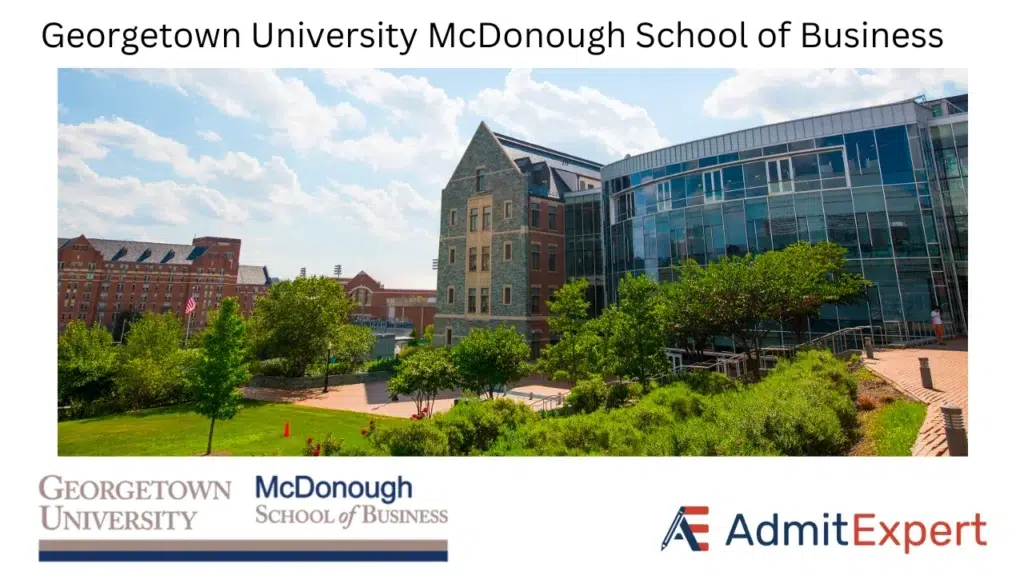
Georgetown McDonough MBA at a Glance
| Metric | Latest official figure |
|---|---|
| University and location | Georgetown University; Washington, D.C. |
| Program | 21-month Full-time MBA |
| Latest published profile | 2026 Full-time MBA entering class |
| Students enrolled | 197 |
| Applications received | 1,269 |
| Average age | 29 |
| Average work experience | 5.3 years |
| Women | 33% |
| International students | 44% |
| Average undergraduate GPA | 3.3 |
| Average GMAT Focus | 626 |
| Average legacy GMAT | 713 |
| Average GRE total | 315 |
| STEM option | STEM-designated Management Science major |
| Class of 2025 average base salary | $146,265 |
| Class of 2025 average signing bonus | $33,768 |
| Job offers within 3 months | 78% |
| Job offers within 6 months | 86% |
| 2026–27 tuition | $75,016 |
| 2026–27 annual cost of attendance | $115,171 |
| Scholarship recipients among fall 2026 entrants | Nearly 60% |
| Average scholarship among recipients | $30,000 per year |
| Next application deadline | Round 1 — October 1, 2026 |
Georgetown's current Full-time MBA class profile labels the cohort by entering year. That is why this guide refers to the "2026 entering class" rather than automatically relabeling it as a graduating class.
The distinction matters because Georgetown also publishes employment data by graduation year. The 2026 entering-class profile and the Class of 2025 employment report describe different groups of students.
What Makes the Georgetown McDonough MBA Distinctive?
Several features interact more strongly at Georgetown than they would if considered separately:
- a redesigned curriculum that integrates business fundamentals with AI, ethics, policy, and leadership;
- Washington, D.C., access to business, government, regulators, associations, nonprofits, and international institutions;
- a required international consulting experience;
- a career process that starts before students arrive and relies heavily on the summer internship;
- a cohort-based learning model;
- certificates and experiential programs that allow deeper career specialization without turning the MBA into a narrow degree.
The result is a program that can work especially well for students who know which part of Georgetown's ecosystem they need to use.
The D.C. location is not the strategy.
It is one of the resources.
Washington, D.C., Matters Most at the Intersection of Business and Institutions
Georgetown's location is most distinctive when a career depends on understanding forces outside the traditional market.
Those can include:
- regulation;
- government;
- geopolitics;
- public-sector procurement;
- international institutions;
- industry associations;
- sustainability policy;
- healthcare policy;
- national security;
- antitrust;
- financial regulation.
The school's Nonmarket Strategy certificate is a particularly clear example.
Its coursework examines how business outcomes are shaped by political, regulatory, legal, social, and cultural forces, with topics such as:
- technology strategy;
- antitrust and business strategy;
- financial markets and regulation;
- national security and the global economy;
- commercial approaches to the public sector;
- the business of defense.
For an applicant whose career sits near those intersections, Washington can become an operating advantage rather than a marketing phrase.
D.C. Is Not the Same Thing as a Government-Focused Employment Market
The current class profile includes 10% of students from government backgrounds.
That does not mean most Georgetown MBAs enter government after graduation.
The school's 2025 employment data is led instead by:
- consulting;
- financial services;
- technology.
That distinction matters.
A location can shape:
- speakers;
- electives;
- institutional access;
- networking;
- regulatory knowledge;
- alumni relationships;
without determining the dominant post-MBA industry.
Applicants should therefore avoid assuming that Georgetown is primarily for public-sector careers simply because it is in Washington.
The Full-time MBA Runs for 21 Months
Georgetown describes the Full-time MBA as a 21-month, in-person program.
Students begin with an intensive opening term before moving into the regular academic calendar.
The program is designed for people who want to:
- accelerate their current career;
- change functions;
- change industries;
- build a new venture;
- add global and leadership experience before returning to the market.
The two-year structure matters because it preserves a conventional summer internship between the first and second years.
As the career data shows, that internship is not peripheral.
It is one of the most important bridges into full-time employment.
Georgetown Redesigned the MBA Curriculum for Fall 2026
The new Full-time MBA curriculum launches in fall 2026.
The redesign emphasizes:
- data and AI fluency;
- ethical decision-making;
- leadership and communication;
- global business;
- policy-driven business decisions;
- greater personalization;
- earlier career alignment.
That is a meaningful change from treating the first year as a long fixed core followed by specialization later.
Georgetown says the redesign was informed by alumni, employers, and the broader McDonough community.
The important implication for applicants is timing.
If the school lets students make career-relevant academic choices earlier, those choices can support internship recruiting rather than arriving after the most important first-year recruiting window.
The Hoya Way Starts the MBA With Ethics, Global Context, and Policy
The new opening term is called The Hoya Way.
It begins with two weeks of intensive instruction around:
- ethical principles;
- global mindset;
- policy-driven business decision-making.
Georgetown also introduced an AI bootcamp into the opening experience.
That combination is revealing.
The school is not treating technology, ethics, and policy as three unrelated topics.
It is positioning them as overlapping parts of modern management.
For someone targeting a heavily regulated or socially consequential industry, that framing can be particularly relevant.
The Core Still Builds a General-Management Foundation
The redesigned curriculum retains foundational coursework in areas such as:
- accounting;
- managerial statistics;
- economics;
- global economics;
- leadership communication;
- ethical leadership;
- finance;
- strategy;
- marketing;
- operations;
- analytics.
That broad foundation matters most when it fills gaps.
A public-sector professional may need finance and commercial strategy.
A banker may need organizational behavior, operations, and leadership.
An engineer may need accounting, marketing, and stakeholder communication.
The goal of the core should not be to deepen only the subject you already know best.
It should expand the set of business problems you can credibly handle.
The New Core Includes Choice Inside Several Disciplines
One of the most important changes in the redesigned curriculum is that some core requirements are satisfied by choosing among alternatives.
For example, the AI requirement includes a choice between:
- AI for Leaders
- Applied AI Lab
Finance, analytics, accounting, strategy, marketing, and operations also include structured choices.
This is different from a purely elective second year.
Students can begin tailoring parts of the required curriculum itself.
That makes course selection more strategic.
A candidate who expects to lead AI adoption needs something different from a candidate who wants deeper hands-on analytical experience.
Georgetown Is Making AI a Core MBA Capability
The curriculum redesign puts AI and digital literacy into the MBA rather than leaving them as optional specialist topics.
Georgetown's 2026 curriculum announcement describes:
- an AI foundations component;
- an opening AI bootcamp;
- AI-related content embedded across the curriculum;
- a choice between AI for Leaders and Applied AI Lab.
That does not mean every MBA student is being trained as a machine-learning engineer.
The more useful interpretation is managerial.
Future managers increasingly need to understand:
- where AI can create value;
- where its outputs are unreliable;
- how to evaluate business use cases;
- how AI changes workflows;
- how to manage ethical and governance risks.
An applicant should decide which of those capabilities is actually missing from their current profile.
Leadership Communication Is Tested Under Pressure
Georgetown's Executive Challenge is embedded in the required Leadership Communications course.
It is a day-long team role-play exercise that simulates high-stakes senior-leadership situations.
Students may have to:
- influence skeptical stakeholders;
- respond to difficult questions;
- persuade;
- motivate;
- manage relationships;
- navigate conflict.
Nearly 140 alumni judges participate in roles such as board members, investors, and executives and provide immediate feedback.
That makes the exercise different from a conventional presentation.
The student is being tested not only on the quality of an answer but on whether they can lead through the interaction.
The Executive Challenge Is Especially Relevant for Strong Technical Candidates
Many MBA applicants already have analytical competence.
Their development gap may be:
- executive presence;
- influence;
- concise communication;
- conflict management;
- persuasion;
- listening;
- responding under pressure.
For those candidates, a leadership simulation can be more useful than another technical elective.
The right application argument is not:
"I want to improve my leadership."
It is:
"This is the leadership behavior I need to improve, and this is the kind of environment in which Georgetown would force me to practice it."
Ethical Leadership Is Designed to Move Beyond Classroom Discussion
The redesigned curriculum also includes an Ethics Project connected to the Ethical Leadership course.
The exercise asks students to turn ethical intent into action rather than treat ethics purely as a case-discussion topic.
That fits Georgetown's wider Jesuit emphasis on:
- service;
- responsibility;
- care for the whole person;
- principled leadership.
Applicants do not need a nonprofit career for that philosophy to matter.
A corporate manager still makes decisions affecting:
- employees;
- customers;
- communities;
- suppliers;
- regulators;
- shareholders.
The useful question is how the applicant wants to exercise judgment when those interests conflict.
The Global Business Experience Is a Required Consulting Project
Georgetown's Global Business Experience is not simply an international trip.
Students work in small teams with executives from multinational organizations on a business problem.
The process runs for several months before travel.
Students then spend a week in the client's country presenting recommendations to organizational leaders.
Projects can involve areas such as:
- market entry;
- market development;
- communications;
- innovation strategy;
- competitive strategy;
- global growth.
That structure makes the international component more useful than short-term exposure alone.
In 2026, Full-Time MBAs Worked Across Six International Markets
For 2026, Georgetown lists 48 Full-Time MBA Global Business Experience projects across:
- Brazil;
- Japan;
- Kenya;
- Spain;
- United Arab Emirates;
- Vietnam.
The geography can change from year to year.
The more important point is the operating model:
remote client work → research and analysis → in-country engagement → final recommendation
For a career switcher, that can create a strong interview example if the project involves work relevant to the target role.
The Best Global Business Experience Is the One That Builds Useful Evidence
The trip itself is not the main value.
A student can travel internationally without changing professionally.
The stronger question is:
What will I know how to do after the project that I cannot credibly demonstrate today?
That might be:
- advising a client;
- working across cultures;
- entering an unfamiliar market;
- conducting primary research;
- handling incomplete information;
- presenting to senior executives;
- translating analysis into a recommendation.
That is how experiential learning becomes career capital.
Georgetown Offers Several MBA Certificates
Students can supplement the MBA with certificates in areas including:
- Consumer Analytics and Insights;
- Global Real Estate;
- Business of Healthcare;
- Nonmarket Strategy;
- Sustainable Business.
These are not substitutes for the MBA.
They are ways to direct elective capacity toward a coherent field.
A certificate can be especially valuable when it solves one of two problems:
- the applicant needs deeper knowledge in the target industry or function;
- the applicant needs a clearer body of work to make a career pivot credible.
The Nonmarket Strategy Certificate Is Unusually Georgetown-Specific
Many MBA programs can offer finance, marketing, or analytics courses.
Fewer are located in an environment where students can directly study the interaction among:
- business;
- regulators;
- policymakers;
- public institutions;
- industry groups.
That makes the Nonmarket Strategy certificate one of the more distinctive ways to use Georgetown's location.
It can be relevant to careers in:
- regulated industries;
- technology policy;
- financial services;
- healthcare;
- defense;
- energy;
- public-sector strategy;
- corporate affairs.
The certificate is most valuable when those issues are central to the post-MBA role, not simply because Washington is nearby.
The Global Real Estate Certificate Adds a Structured Real-Estate Path
Georgetown's Global Real Estate certificate combines MBA electives with resources from the Steers Center for Global Real Assets.
The current certificate requires a 7.5-credit sequence.
It is designed around commercial real-estate skills and applied exposure.
That matters because real estate represents 8% of Class of 2025 industry placements—large enough to be a visible pathway, but still smaller than consulting, finance, or technology.
A candidate targeting real estate should therefore research the actual role:
- acquisitions;
- development;
- real-estate private equity;
- asset management;
- finance;
- strategy.
"Real estate" alone is still too broad.
Small Business Corps Adds a Local Consulting Route
The Small Business Corps pairs MBA students with small businesses in the Washington region for project-based consulting.
Georgetown reports that students have worked with 41 businesses, completed more than 50 projects, and contributed more than 24,800 consulting hours since the initiative began.
The scale is useful.
But the career value still depends on the assignment.
A student interested in growth strategy may benefit from a very different project from someone trying to demonstrate operational execution or marketing analytics.
Georgetown's Cohort Model Creates Repeated Interaction
The redesigned curriculum says Full-time MBA students learn within cohorts of roughly 50–70 peers.
The broader MBA comparison page describes four Full-time cohorts averaging about 60 students.
That creates a smaller repeated learning unit inside the full class.
For some students, that can produce:
- closer peer relationships;
- repeated teamwork;
- more familiarity with classmates;
- a stronger support system.
The trade-off is that the same students see one another frequently.
Applicants who prefer a very large, highly fluid classroom environment should consider that difference directly.
More Than 40 MBA Student Organizations Extend Learning Beyond Class
Georgetown currently lists 40+ MBA student organizations.
Career-oriented clubs cover areas such as:
- consulting;
- finance;
- technology;
- energy and cleantech;
- real estate;
- healthcare;
- marketing;
- operations;
- fintech;
- entrepreneurship through acquisition.
The clubs matter most during recruiting.
The Georgetown Consulting Club, for example, emphasizes:
- industry education;
- applications;
- interview preparation;
- employer relationships;
- alumni connections.
A club is therefore not simply a line on a resume.
It can become part of the recruiting infrastructure.
The Full-Time MBA Has a STEM-Designated Management Science Major
Georgetown does not describe every possible Full-Time MBA course plan as automatically STEM-designated.
Instead, students can complete a STEM-designated Management Science major by satisfying specified quantitative core and elective requirements.
The distinction matters for international applicants.
If STEM designation is important to your work-authorization plan, course selection needs to be managed deliberately.
STEM Designation Does Not Eliminate International Recruiting Risk
STEM status can improve the work-authorization runway for eligible international graduates under current U.S. rules.
It does not guarantee:
- an internship;
- an offer;
- employer sponsorship;
- H-1B selection;
- long-term U.S. employment.
Georgetown's own Class of 2025 outcomes show why this distinction matters.
International students had different three-month employment outcomes from the overall class.
Academic classification and hiring-market reality are separate issues.
Georgetown McDonough MBA Class Profile: 2026 Entering Class
Georgetown's latest Full-time MBA class profile reports 197 enrolled students from 1,269 applications.
Class Composition
| Metric | 2026 entering class |
|---|---|
| Students enrolled | 197 |
| Applications received | 1,269 |
| Women | 33% |
| International students | 44% |
| Countries represented | 33 |
| First-generation students | 13% |
| Underrepresented minorities | 41% |
| U.S. military | 17% |
| Average age | 29 |
| Average work experience | 5.3 years |
The school defines U.S. military representation as including active-duty and reserve service members as well as veterans.
197 Enrolled Students Does Not Mean a 15.5% Acceptance Rate
Dividing:
197 ÷ 1,269
would produce an enrollment-to-application ratio of roughly 15.5%.
That is not an acceptance rate.
A true acceptance rate requires the number of applicants who received admission offers.
The class-profile page does not publish that number.
Some admitted students choose other schools, so enrollment is smaller than the number admitted.
The Current Entering Class Is Smaller Than the Prior Cohort
Georgetown reported 248 students in the cohort that entered in fall 2025.
The current 2026 entering profile reports 197.
That is a meaningful one-year decrease in class size.
Several other measures changed as well:
| Metric | 2025 entering cohort | 2026 entering cohort |
|---|---|---|
| Students | 248 | 197 |
| Women | 31% | 33% |
| International | 44% | 44% |
| First-generation students | 21% | 13% |
| U.S. military | 13% | 17% |
| Average work experience | 5.0 years | 5.3 years |
| Average undergraduate GPA | 3.3 | 3.3 |
| Average GRE | 318 | 315 |
One year's movement should not automatically be treated as a permanent admissions trend.
But the comparison is useful for showing that class composition can change materially even when headline averages remain stable.
International Representation Remains High
International students account for 44% of the current entering class.
That is the same percentage Georgetown reported for the cohort entering in 2025.
The current profile represents 33 countries.
Applicants should still be careful when comparing international percentages across schools.
Different institutions can define "international" differently.
The safer comparison is to use each school's published definition and avoid treating every percentage as perfectly standardized.
Military Representation Is a Significant Part of the Class
Georgetown reports 17% U.S. military in the current entering class.
That is a substantial share.
Military applicants may find the environment valuable because many peers understand:
- leadership under pressure;
- large-team responsibility;
- operational complexity;
- mission-oriented organizations.
But rank or service alone does not explain business-school readiness.
A strong application translates military work into language the admissions committee can evaluate:
- scope;
- decision authority;
- resources;
- people;
- outcomes;
- lessons.
Pre-MBA Industry Backgrounds Are More Diverse Than the Employment Outcomes
Georgetown highlights the following major incoming industries:
| Pre-MBA industry | Share of class |
|---|---|
| Financial Services | 19% |
| Education | 14% |
| Government | 10% |
| Consulting | 9% |
| Technology & New Media | 5% |
| Consumer Goods & Retail | 5% |
Education is the second-largest highlighted pre-MBA industry.
Government is third.
That is a very different pattern from the Class of 2025 post-MBA industry distribution, where consulting and financial services dominate.
This is useful evidence that Georgetown's student body is not simply populated by people already working in the industries that hire the most graduates.
Career transition is part of the MBA story.
Applicants From Education or Government Should Translate Their Experience
An educator may have experience in:
- stakeholder management;
- budget constraints;
- organizational change;
- program design;
- performance measurement.
A public-sector professional may have experience in:
- regulation;
- procurement;
- large-scale implementation;
- cross-agency coordination;
- public accountability.
Those are business-relevant capabilities.
The application still needs to make them legible.
Do not assume that an admissions reader will automatically translate a specialized job title into the leadership and analytical skills behind it.
Undergraduate Backgrounds Are Broad
| Undergraduate field | Share of class |
|---|---|
| Business | 36% |
| Engineering | 18% |
| Government / International Studies | 13% |
| Economics | 12% |
| Computer Science | 4% |
| Humanities | 4% |
Business is the largest single field.
But 64% of the class studied something else.
That means the MBA is not built only for applicants who already have formal business training.
The more important issue is whether the complete application demonstrates enough:
- quantitative readiness;
- analytical reasoning;
- professional progression;
- leadership.
Georgetown MBA GMAT, GRE, and GPA
The current profile reports averages, not medians.
| Academic metric | Average | Middle 80% range |
|---|---|---|
| Undergraduate GPA | 3.3 | 2.86–3.8 |
| GMAT Focus | 626 | 555–682 |
| Legacy GMAT | 713 | 672–752 |
| GRE total | 315 | 299–330 |
Georgetown also reports that approximately 30% of the current entering class submitted GRE scores.
Current and Legacy GMAT Scores Must Stay Separate
The 626 GMAT Focus average and 713 legacy GMAT average come from different versions of the exam.
They use different score scales.
It would be incorrect to say:
"Georgetown's GMAT fell from 713 to 626."
Those numbers are not directly comparable.
Applicants taking the current GMAT should evaluate themselves against current-format scores and percentiles.
A Middle-80% Range Is Not a Minimum Score
The current GMAT Focus middle 80% is 555–682.
The GRE middle 80% is 299–330.
That means approximately 80% of the relevant enrolled scores fell within those intervals.
It does not mean:
- 555 is a GMAT cutoff;
- 299 is a GRE cutoff;
- a score above the upper bound guarantees admission.
The class profile describes enrolled students.
It does not publish a formula for admission.
Georgetown Accepts GMAT, GRE, and Executive Assessment
The current application requirements allow Full-time MBA applicants to submit:
- GMAT;
- GRE;
- Executive Assessment.
Valid current scores must have been taken within the last five years.
Georgetown also accepts expired GMAT or GRE scores under its current policy.
That gives applicants more than one testing route.
Georgetown Now Uses a Pre-Assessment Process
The MBA Pre-assessment allows candidates to submit a shorter set of materials before completing the full MBA application.
It includes:
- unofficial transcripts;
- resume;
- optional test scores;
- a brief application form.
Georgetown says candidates typically receive feedback within 10 business days.
Possible guidance includes:
- continue with the full application;
- continue and be considered for a test waiver;
- continue and submit a standardized test;
- consider another McDonough program.
That makes the pre-assessment more than a generic eligibility form.
It can influence the testing strategy before the applicant invests in the full submission.
A Test Waiver Is Not the Same as Universal Test-Optional Admission
Applicants seeking a waiver can use the pre-assessment process to present evidence of quantitative readiness.
The waiver response asks candidates to explain why they can succeed in Georgetown's quantitative MBA coursework without a standardized score.
That makes the relevant question:
"What evidence replaces the test?"
Possible evidence can come from:
- quantitative coursework;
- strong academic performance;
- analytical professional responsibilities;
- finance;
- engineering;
- statistics;
- data work.
A waiver removes a test requirement.
It does not remove the need to establish academic readiness.
Georgetown MBA Application Requirements 2026–27
The current Full-time MBA application includes:
- application form;
- transcripts;
- resume;
- test score or applicable waiver route;
- one written personal essay;
- one video essay;
- one recommendation;
- interview if invited;
- $175 application fee unless reduced or waived;
- English-language evidence where required.
This is more streamlined than applicants may expect from older Georgetown application guides.
Georgetown Requires One 500-Word Essay Chosen From Three Prompts
Applicants choose one of three current personal-essay options.
The maximum length is 500 words.
Option 1: Georgetown Community
This prompt asks how the applicant's personal, educational, familial, cultural, economic, social, or other experiences would add perspectives to Georgetown.
The challenge is specificity.
A strong response does not simply list identities or communities.
It shows how experiences shaped:
- judgment;
- assumptions;
- behavior;
- contribution.
Option 2: Human-Centered Leadership
This prompt asks what human qualities become more important as AI becomes more integrated into work and how the applicant has demonstrated those qualities.
This is not primarily an AI essay.
It is a leadership essay framed by technological change.
The strongest responses connect a belief about leadership to an actual experience.
Option 3: Achieving Excellence
This prompt asks the applicant to revisit a professional experience from the resume where they achieved outstanding results.
The risk is writing the resume achievement again.
The opportunity is to explain:
- why the result was difficult;
- which strengths produced it;
- what the applicant learned;
- how those qualities would shape the Georgetown community.
For detailed strategy on the current prompts, use Admit Expert's Georgetown McDonough MBA essay analysis.
Georgetown's One-Minute Video Essay Is Intentionally Personal
The current video prompt asks applicants to share:
what has recently brought them joy outside of work.
The limit is one minute.
Georgetown recommends an unscripted, conversational response.
That makes the weakest use of the video a second professional pitch.
The school has already seen:
- resume;
- professional experience;
- leadership evidence;
- essay.
The video creates room to reveal something different.
That can be:
- a hobby;
- relationship;
- activity;
- curiosity;
- community;
- personal ritual;
- recent experience.
The goal is not to manufacture eccentricity.
It is to become more understandable as a person.
Georgetown Requires One Recommendation
Only one recommendation is required.
For Full-time MBA applicants, a current supervisor is strongly preferred.
Georgetown wants someone who can objectively assess:
- professional performance;
- managerial potential;
- leadership potential.
That makes direct knowledge more useful than title.
A senior executive who barely knows the applicant may be less valuable than a manager who has observed:
- difficult work;
- progression;
- feedback;
- interpersonal behavior;
- decision-making.
Georgetown Interviews Are Invitation-Only
MBA interviews are offered by invitation only.
Invitations can be sent after each application deadline and continue until the decision-release date.
A waitlisted applicant may also be invited later.
The interview is therefore part of the admissions evaluation.
Applicants should be prepared to connect:
- career goals;
- prior decisions;
- why MBA;
- why Georgetown;
- program fit;
- contribution.
Georgetown MBA Application Deadlines 2026–27
| Round | Application deadline | Full-time MBA decision notification |
|---|---|---|
| Early Action | September 9, 2026 | October 29, 2026 |
| Round 1 | October 1, 2026 | December 10, 2026 |
| Round 2 | January 6, 2027 | March 19, 2027 |
| Round 3 | April 1, 2027 | May 13, 2027 |
| Round 4 | May 17, 2027 | June 4, 2027 |
Applications are due by 11:59 p.m. Eastern Time.
As of September 28, 2026, Early Action has passed.
The next Full-time MBA deadline is therefore:
Round 1 — October 1, 2026
Georgetown Early Action Is Binding
This is one of the most important admissions details in the cycle.
If admitted through Early Action, the applicant agrees to:
- attend Georgetown;
- withdraw competing applications;
- not submit new applications.
That makes Early Action fundamentally different from simply applying early.
An applicant should use the binding round only when Georgetown is genuinely the first choice and the financing implications have been considered.
Early Action Is Also the Gateway to the Dean's Fellowship
Full-time MBA candidates who want to be considered for the Dean's Fellowship must apply in Early Action.
That creates a real trade-off.
Early Action can provide access to a scholarship opportunity that is unavailable in later rounds.
But the applicant is also accepting a binding admissions commitment.
The scholarship possibility should not be treated as guaranteed funding.
International Applicants Are Encouraged to Apply Earlier
Georgetown encourages applicants who will need an F-1 visa to apply in:
- Early Action;
- Round 1;
- Round 2.
The purpose is to allow more time for I-20 processing and pre-arrival planning.
This is an encouragement, not the same thing as saying every later-round international application is automatically prohibited.
Two Enrollment Deposits Total $4,000
To formally accept an admission offer, Georgetown currently requires:
- first nonrefundable deposit: $2,000;
- second nonrefundable deposit: $2,000.
That means admitted students need to plan for $4,000 in deposits on the school's published schedule.
The timing can matter for applicants comparing financing and admission offers.
Georgetown Also Offers Deferred Admission Through MAAP
The MBA Advanced Access Program is Georgetown's deferred-admission pathway.
It is designed for students in the final year of an undergraduate or graduate program who do not yet have professional full-time work experience.
Admitted students can defer for:
- two years;
- three years;
- four years.
They are expected to build professional experience before joining the Full-time MBA.
MAAP Has Its Own Application Timing
For the current cycle, MAAP uses the dates corresponding to the regular MBA's Round 3 and Round 4:
| MAAP round | Application deadline | Decision notification |
|---|---|---|
| MAAP Round 1 | April 1, 2027 | May 13, 2027 |
| MAAP Round 2 | May 17, 2027 | June 4, 2027 |
The initial deposit is $500.
Deferred admission should not be viewed simply as securing an MBA seat early.
The intervening years should build:
- professional judgment;
- responsibility;
- clearer goals;
- evidence that makes the eventual MBA more useful.
Georgetown MBA Employment Report: Class of 2025
Georgetown's MBA career page reports:
| Career metric | Class of 2025 |
|---|---|
| Average base salary | $146,265 |
| Average signing bonus | $33,768 |
| Job offer within 3 months | 78% |
| Job offer within 6 months | 86% |
| Full-time acceptances converted from internships | 42% |
The salary is an average, not a median.
That distinction matters because an average can be pulled upward or downward by the distribution of reported salaries.
The signing bonus is also an average and should not be automatically added to the average base salary as though every salary respondent received the same bonus.
The Three-Month and Six-Month Offer Rates Describe Different Moments
Georgetown reports:
- 78% receiving offers within three months;
- 86% receiving offers within six months.
The later number should not replace the earlier one.
It tells us something different.
Some graduates who had not secured offers by the conventional three-month checkpoint continued searching and received offers later.
That has practical implications for:
- emergency savings;
- loan planning;
- rent;
- visa timelines;
- expectations about post-graduation cash flow.
Employment by Industry
| Industry | Share of Class of 2025 placements |
|---|---|
| Consulting | 25% |
| Financial Services | 25% |
| Technology | 16% |
| Real Estate | 8% |
| Manufacturing | 6% |
| Healthcare | 5% |
| Hospitality | 5% |
These are the leading industries Georgetown highlights in its official Class of 2025 employment announcement.
Consulting and financial services together account for 50%.
Adding technology brings the three largest sectors to 66%.
That is a concentrated employment mix.
Georgetown supports many career paths.
Its largest current pipelines are still consulting, finance, and technology.
Consulting Is One of Georgetown's Two Largest Career Markets
Consulting accounts for 25% of Class of 2025 industry placements.
The employer list includes firms such as:
- Boston Consulting Group;
- Deloitte;
- EY;
- McKinsey & Company;
- PwC.
For a career changer, consulting can provide a relatively structured route through:
- summer internship recruiting;
- case interviews;
- repeat MBA hiring;
- office-specific recruitment.
Georgetown's consulting club and career infrastructure can support that process.
The industry percentage does not guarantee access to every firm or office.
Financial Services Is Equally Large
Financial services also accounts for 25% of placements.
Georgetown's named Class of 2025 employers include:
- Bank of America;
- Jefferies Financial Group;
- JPMorganChase;
- M&T Bank.
But "financial services" is not one career.
Applicants should distinguish among:
- investment banking;
- corporate finance;
- investment management;
- private equity;
- venture capital;
- fintech;
- commercial banking.
Those markets use different recruiting processes.
Technology Reached 16% of Class of 2025 Placements
Technology represents 16% of the current industry mix.
The named employer list includes Amazon and Microsoft.
That gives Georgetown a meaningful technology pathway.
It does not mean 16% of graduates became product managers.
Industry and function are different dimensions.
A technology company can hire MBAs into:
- finance;
- strategy;
- marketing;
- operations;
- product;
- sales;
- business development.
Applicants should define the function before deciding whether the technology share supports their goal.
Real Estate Is a Visible Georgetown Pathway
Real estate accounts for 8% of Class of 2025 industry placements.
That is large enough to matter.
It also connects directly with the Global Real Estate certificate and Steers Center ecosystem.
A candidate interested in commercial real estate should go one level deeper and determine whether the target is:
- development;
- acquisitions;
- private equity;
- asset management;
- finance;
- investment strategy.
The 8% industry number cannot answer that by itself.
Georgetown's Employment Mix Shifted From 2024 to 2025
The school's official Class of 2024 and Class of 2025 summaries show a notable one-year change:
| Industry / outcome | Class of 2024 | Class of 2025 |
|---|---|---|
| Offer within 3 months | 88.8% | 78% |
| Consulting | 36% | 25% |
| Financial Services | 27% | 25% |
| Technology | 8% | 16% |
| Real Estate | 5% | 8% |
| Manufacturing | 8% | 6% |
| Healthcare | 3% | 5% |
Technology doubled its share from 8% to 16%.
Consulting fell from 36% to 25%.
The three-month offer rate also fell materially.
Those facts describe what happened between two graduating classes.
They do not establish a permanent trend or prove why the mix changed.
Employer demand, student preferences, cohort composition, and the broader hiring market can all influence one year's results.
Salary Should Not Be Compared Mechanically Across the Two Years
The Class of 2024 school summary highlighted a median base salary of $148,000.
The Class of 2025 career materials highlight an average base salary of $146,265.
Median and average are different statistics.
It would therefore be misleading to describe the difference as a $1,735 salary decline.
The correct conclusion is that the public summaries are using different measures.
International Students Faced a Different Employment Market
For the Class of 2025, Georgetown reports that international students had:
- 72% receiving offers within three months;
- $144,515 average base salary;
- $29,379 average signing bonus.
The overall three-month offer figure is 78%.
That gap is relevant for international applicants.
It does not prove that every international candidate faces the same outcome.
But it reinforces the need to research:
- sponsorship;
- STEM eligibility;
- industry;
- employer policy;
- geography;
- work authorization.
The Internship Pipeline Is Central to Georgetown's Career Model
One of the most important numbers in the employment reporting is:
42% of full-time acceptances came from internship conversions.
That means the summer internship is not merely an exploratory experience.
For a substantial share of the class, it becomes the bridge to the permanent role.
The career path often looks like:
first-year preparation → internship recruiting → summer performance → return offer
That makes the first year strategically important.
Class of 2026 Internship Outcomes Were Stronger Than the Full-Time Offer Headline
Georgetown reports that among the Class of 2026:
- 94% of students seeking internships secured one;
- average monthly internship compensation was $8,109;
- 74% of internships were facilitated through school connections.
Those figures describe internship outcomes for a different cohort from the Class of 2025 full-time employment results.
They should not be combined into one employment rate.
But they do show how heavily the career model uses school-supported internship access.
Career Preparation Starts Before Students Arrive
The McDonough Career Center begins working with students through a summer webinar and career-development sequence before the academic year.
Students then have access to:
- industry-aligned career coaches;
- peer advisors;
- recruiting events;
- career days;
- treks;
- employer information sessions;
- interview preparation;
- alumni relationships.
That matters because several MBA recruiting processes begin early.
Waiting until the spring semester to define a target role can leave a career changer behind the recruiting calendar.
Career Treks Expand Access Beyond Washington
McDonough's career experience includes treks focused on industries and geographies such as:
- consulting;
- California technology;
- energy;
- entrepreneurship;
- healthcare;
- marketing;
- Wall Street and real estate.
This is useful for applicants who like Georgetown's D.C. location but do not intend to remain in Washington.
A trek does not create the same depth of local access as living in the target market.
It does create a structured way to build employer exposure outside D.C.
Entrepreneurship Has a Different Career Logic
Georgetown Entrepreneurship offers several routes that do not fit neatly into conventional campus recruiting.
The MBA Startup Fellowship provides $10,000 to selected students working on their startup instead of pursuing a conventional summer internship.
The Georgetown Ventures Fellows program gives students a one-year apprenticeship experience with a venture-capital or private-equity firm.
Those paths serve different goals:
- founding;
- venture investing;
- startup experience;
- entrepreneurial skill-building.
A founder should not judge success only by whether a salaried offer appears in an employment table.
The relevant milestones may instead be:
- customer demand;
- product development;
- fundraising;
- cofounder formation;
- revenue;
- market validation.
Georgetown MBA Tuition and Cost of Attendance 2026–27
Georgetown's current Full-time MBA tuition page lists:
| Expense | 2026–27 annual amount |
|---|---|
| Tuition | $75,016 |
| Graduate Student Activity Fee | $54 |
| Georgetown health insurance, estimated | $4,785 |
| Direct-expense subtotal | $79,855 |
| Housing and food | $24,180 |
| Personal expenses | $5,300 |
| Books and supplies | $2,646 |
| Transportation | $3,130 |
| Federal Direct Loan fees, estimated | $60 |
| Indirect-expense subtotal | $35,316 |
| Total annual cost of attendance | $115,171 |
Health insurance may be waived for students who meet the university's coverage requirements.
$75,016 Is Tuition—Not the Total Annual Cost
This distinction is fundamental.
The published tuition is:
$75,016
The published annual cost of attendance is:
$115,171
The difference includes:
- university fees;
- health insurance;
- housing and food;
- books;
- transportation;
- personal expenses;
- estimated loan fees.
An article calling $115,171 "Georgetown MBA tuition" would be wrong.
$115,171 Is Also Not the Full 21-Month MBA Cost
The cost-of-attendance table is an annual estimate.
The Full-time MBA lasts 21 months.
An applicant entering in fall 2027 should therefore not simply interpret $115,171 as the price of the degree.
A realistic financial model should account for:
- the applicable tuition rate for the entering year;
- second-year costs;
- living expenses;
- health insurance;
- financing costs;
- travel;
- optional activities;
- foregone salary.
The 2026–27 Cost Is a Reference Point for Fall 2027 Applicants
The admissions cycle in this guide leads to fall 2027 enrollment.
The currently published cost table is for 2026–27.
That means the $75,016 tuition and $115,171 annual cost-of-attendance figures are the latest official planning reference, not a guaranteed fall 2027 price.
This is especially important because Georgetown's tuition-lock policy starts only after the relevant student enrolls.
Georgetown Introduced a Tuition Lock Beginning in Fall 2026
Under the current policy, Full-time MBA students who enroll can retain their tuition rate for up to four academic years, subject to the policy's eligibility rules.
That improves predictability for students whose degree extends across multiple academic years.
The lock applies to tuition.
It does not freeze:
- housing;
- food;
- insurance;
- transportation;
- personal expenses;
- every university fee.
Deferring Can Change the Locked Tuition Rate
Georgetown's policy states that students who defer entry forfeit the locked rate from the original admission year.
Dual-degree students receive the lock based on the academic year in which they actually begin the McDonough Full-time MBA portion.
That means the tuition lock should not be understood as an admission-year price guarantee independent of enrollment.
Opportunity Cost Belongs in the MBA Price
A full-time MBA also costs the compensation you give up while studying.
For someone leaving:
- consulting;
- finance;
- technology;
- government;
- military service;
- another professional role;
foregone salary and benefits can be substantial.
The more useful investment calculation is:
net direct cost + financing cost + foregone earnings
compared with:
the career access, skills, network, and long-term trajectory available with and without the MBA.
Georgetown MBA Scholarships
Georgetown says more than $4 million is available to MBA applicants through scholarships.
Among Full-time MBA students who began in fall 2026:
- nearly 60% received scholarship funding;
- recipients received an average of $30,000 per year.
Those figures show that scholarship support is meaningful.
They do not predict what any individual applicant will receive.
General Merit Scholarship Consideration Is Automatic
All completed Georgetown MBA applications are automatically considered for the general merit scholarship.
The school evaluates areas including:
- academic accomplishments;
- professional achievements;
- ethical leadership;
- service.
No separate general merit application is required.
That is different from several named awards, which can have additional criteria or prompts.
The Recipient Average Is Not a Scholarship Promise
The $30,000-per-year average applies to scholarship recipients.
It is not:
- the average across every enrolled student;
- a guaranteed award;
- a minimum award.
The safest initial financial plan still assumes:
no scholarship until one is confirmed.
Dean's Fellowship Has a Different Structure
The Dean's Fellowship is available only to high-merit Full-time MBA candidates admitted through Early Action.
The current fellowship includes:
- a minimum merit scholarship of $25,000 per year;
- a travel scholarship of up to $400 for an eligible affinity career conference;
- priority consideration for selected student leadership opportunities;
- faculty mentorship and programming.
The key admissions implication is timing.
A later-round applicant cannot simply apply for the Dean's Fellowship afterward.
The Binding Nature of Early Action Makes Dean's Fellowship a Real Trade-Off
An applicant interested in the fellowship has to weigh two things together:
- access to Dean's Fellowship consideration;
- a binding commitment to attend Georgetown if admitted.
That decision should be made before the application goes in.
The possibility of an award should not be confused with a confirmed award.
Georgetown Has Several Targeted Scholarship Routes
Current Full-time MBA scholarship opportunities include awards connected to:
- first-generation background;
- women in STEM advocacy;
- gender equity;
- Minority-Serving Institution alumni;
- international and regional experience;
- real estate;
- fintech;
- entrepreneurship;
- World Bank affiliation;
- Georgetown alumni;
- nonprofit service;
- Jesuit education;
- military service and external partnerships.
The eligibility rules differ.
Meeting an eligibility criterion means an applicant can be considered.
It does not guarantee funding.
The John F. Dealy Scholarship Requires an Additional Response
The John F. Dealy Scholarship focuses on demonstrated support for gender equity in technology, finance, or consulting.
Applicants who want to be considered answer an additional 250-word question in the application.
That makes it a useful example of why "automatic scholarship consideration" should not be generalized to every named award.
Some funding routes require additional action.
Is Georgetown McDonough a Good MBA for Consulting?
Consulting is tied for the largest Class of 2025 industry at 25%.
Georgetown also offers:
- consulting-focused student organizations;
- case preparation;
- career coaches;
- employer events;
- Small Business Corps;
- Global Business Experience consulting projects.
For a career changer, the combination can be useful because it creates both preparation and evidence.
The applicant should still research:
- target firms;
- target offices;
- internship recruiting;
- case interview expectations;
- visa policies.
Is Georgetown McDonough a Good MBA for Finance?
Financial services also accounts for 25% of current industry placements.
Georgetown can support finance through:
- core finance;
- electives;
- Finance Club;
- fintech resources;
- Washington regulatory access;
- alumni;
- Wall Street and real-estate treks.
The strongest finance applicant is specific.
Investment banking and investment management are different searches.
Private equity and venture capital are different again.
A broad "finance" goal is not enough to evaluate fit.
Is Georgetown McDonough a Good MBA for Technology?
Technology represents 16% of Class of 2025 placements.
The redesigned curriculum's AI and analytics emphasis also makes technology more visible academically.
But "technology" is still an industry, not a function.
A student may work in:
- product;
- marketing;
- finance;
- strategy;
- operations;
- business development.
The employment percentage should therefore be treated as evidence of employer activity, not proof of equal access to every technology role.
Is Georgetown McDonough a Good MBA for Government or Public-Sector Work?
Georgetown's Washington location creates an unusually strong environment for understanding the interaction between business and public institutions.
The program can be relevant for applicants interested in:
- public-sector consulting;
- federal contracting;
- regulated industries;
- policy;
- international institutions;
- economic development;
- defense;
- government-facing corporate strategy.
But the current employment mix is not dominated by government.
The strongest case for Georgetown is usually an intersectional one:
business expertise + policy/institutional understanding
rather than simply wanting to work near government.
Is Georgetown McDonough a Good MBA for International Careers?
The class profile is 44% international, and the required Global Business Experience gives every student a structured cross-border consulting project.
Georgetown also emphasizes a global alumni network and international business education.
Those are real advantages.
International applicants should still separate two questions:
- Is the program globally oriented?
- Does my target employer and geography support my work-authorization and hiring needs?
The answer to the first cannot substitute for the second.
Is Georgetown McDonough a Good MBA for Real Estate?
Real estate represents 8% of Class of 2025 industry placements.
The Global Real Estate certificate and Steers Center create a dedicated academic and professional ecosystem.
That makes real estate more than a minor elective interest at Georgetown.
Applicants should still define the role:
- acquisitions;
- development;
- asset management;
- private equity;
- finance;
- strategy.
Is Georgetown McDonough a Good MBA for Entrepreneurship?
Georgetown supports entrepreneurship through:
- MBA Startup Fellowship;
- Venture Fellows;
- entrepreneurship coursework;
- pitch competitions;
- Georgetown Entrepreneurship;
- Washington's startup ecosystem.
The key question is which entrepreneurial path you want:
- start a company;
- join a startup;
- invest in startups;
- pursue entrepreneurship through acquisition;
- bring entrepreneurial skills into a larger organization.
Each path uses Georgetown differently.
Who Should Consider Georgetown McDonough Most Seriously?
McDonough deserves close consideration if you value:
- Washington, D.C.;
- consulting;
- financial services;
- technology;
- real estate;
- business-government interaction;
- global business;
- international consulting;
- AI and data fluency;
- ethics and principled leadership;
- a cohort-based MBA;
- applied learning;
- certificates in targeted fields;
- a strong military and international presence in the class.
Applicants should think more carefully if they strongly prefer:
- a curriculum with little required global or ethics content;
- a fully automatic STEM designation regardless of course plan;
- a much larger MBA class;
- a program where public-policy and global-business themes are less central.
The strongest Georgetown fit is usually specific.
Washington should be part of how the plan works, not the entire reason for the plan.
How to Decide Whether Georgetown Fits Your MBA Goals
1. Define the post-MBA job precisely
Specify:
- function;
- industry;
- geography;
- employer type.
"Technology" is not a complete goal.
Neither is "international business."
2. Identify what prevents you from making that move today
Is the gap:
- business fundamentals?
- finance?
- data?
- AI literacy?
- leadership communication?
- consulting experience?
- regulatory knowledge?
- network?
- international exposure?
The MBA should solve something concrete.
3. Build a Georgetown development path
Connect those gaps to:
- redesigned core;
- AI pathway;
- electives;
- certificate;
- Executive Challenge;
- Global Business Experience;
- Small Business Corps;
- student organizations;
- internship;
- D.C. ecosystem.
4. Test the employment data at the right level
Do not use the 16% technology share to justify an unspecified product-management goal.
Do not use the 25% financial-services share to justify private equity.
Do not use Georgetown's Washington location to assume government is the dominant recruiting market.
Research the actual route.
5. Model the financial commitment separately
Include:
- current tuition as a reference;
- future entering-year tuition;
- living costs;
- insurance;
- confirmed scholarship;
- financing;
- two enrollment deposits;
- foregone salary;
- cash reserve for a longer job search.
Do not count an unconfirmed scholarship as funding.
Georgetown McDonough MBA FAQs
What is the latest Georgetown McDonough Full-time MBA class profile?
Georgetown's latest official page is the 2026 Full-time MBA entering-class profile, with 197 enrolled students from 1,269 applications.
What is Georgetown McDonough's MBA acceptance rate?
The current class-profile page does not publish the number of admission offers, so a true current acceptance rate cannot be calculated from official profile data alone.
Dividing enrolled students by applications would produce an enrollment-to-application ratio, not an acceptance rate.
What is the average GMAT at Georgetown McDonough?
The current profile reports an average GMAT Focus score of 626 and an average legacy GMAT score of 713.
The two exams use different score scales.
What is the average GRE at Georgetown McDonough?
The current entering class reports an average GRE total of 315, with a 299–330 middle-80% range.
What is the average GPA at Georgetown McDonough?
The current profile reports an average undergraduate GPA of 3.3, with a 2.86–3.8 middle-80% range.
How much work experience do Georgetown MBA students have?
The current entering class averages 5.3 years of professional experience.
Does Georgetown McDonough require the GMAT or GRE?
Georgetown accepts the GMAT, GRE, or Executive Assessment for the Full-time MBA and also accepts expired GMAT/GRE scores under its current policy.
Eligible applicants may be considered for a standardized-test waiver through the MBA pre-assessment process.
Is Georgetown McDonough test-optional?
Not in the simple sense of allowing every applicant to omit testing automatically.
Applicants who want a waiver use the pre-assessment process and provide evidence that supports quantitative readiness.
How many essays does Georgetown require?
The fall 2027 Full-time MBA application requires one 500-word written personal essay, chosen from three prompts, plus a one-minute video essay.
An optional 300–350-word essay is available for additional information.
How many recommendations does Georgetown require?
Georgetown requires one recommendation.
A current supervisor is strongly preferred for Full-time MBA applicants.
Is the Georgetown MBA interview required?
Interviews are invitation-only.
An applicant must receive an invitation from the admissions team rather than scheduling a standard interview automatically.
What is the Georgetown MBA application fee?
The standard application fee is $175.
Georgetown offers fee waivers or reductions to several eligible applicant groups.
Is Georgetown Early Action binding?
Yes.
An admitted Early Action applicant agrees to attend Georgetown, withdraw competing applications, and not submit new applications.
What is the next Georgetown MBA deadline?
As of September 28, 2026, the next Full-time MBA deadline is:
Round 1 — October 1, 2026 at 11:59 p.m. Eastern Time
Does Georgetown offer deferred MBA admission?
Yes.
The MBA Advanced Access Program (MAAP) allows eligible final-year undergraduate or graduate students without prior professional full-time work experience to apply for deferred admission.
Students can defer for two to four years.
Is Georgetown McDonough STEM-designated?
Georgetown offers a STEM-designated Management Science major within the MBA.
Students must complete the specified quantitative core and elective requirements.
What is the Georgetown MBA salary?
For the Class of 2025, Georgetown reports an average base salary of $146,265.
The average signing bonus is $33,768.
What percentage of Georgetown MBA graduates receive job offers?
Georgetown reports 78% receiving an offer within three months of graduation and 86% within six months for the Class of 2025.
The reporting periods should not be treated as interchangeable.
Which industries hire the most Georgetown MBAs?
For the Class of 2025:
- consulting — 25%;
- financial services — 25%;
- technology — 16%.
Together they account for 66% of the leading reported industry placements.
How important is the summer internship at Georgetown?
Very important.
Georgetown reports that 42% of full-time acceptances were converted from internships for the Class of 2025.
For the Class of 2026, 94% of students seeking internships secured one.
How much is Georgetown McDonough tuition?
For 2026–27, Georgetown publishes $75,016 in annual tuition.
The published annual cost of attendance is $115,171.
Applicants entering in fall 2027 should use these as current reference figures rather than guaranteed 2027–28 prices.
Does Georgetown lock MBA tuition?
Yes.
Beginning with fall 2026 enrollment, qualifying Full-time MBA students can retain their tuition rate for up to four academic years.
The lock applies to tuition, not the entire cost of attendance.
How many Georgetown MBA students receive scholarships?
Georgetown says nearly 60% of Full-time MBA students who began in fall 2026 received scholarship funding.
Among recipients, the average award was $30,000 per year.
Does Georgetown automatically consider applicants for scholarships?
Completed MBA applications are automatically considered for the general merit scholarship.
Some named scholarships have additional eligibility rules or application requirements.
What is the Georgetown Dean's Fellowship?
The Dean's Fellowship is a selective award for high-merit Full-time MBA admits who apply through Early Action.
The current fellowship includes a minimum merit scholarship of $25,000 per year plus additional leadership, mentorship, and career benefits.
Final Thoughts
Georgetown McDonough is most compelling when its different strengths are used together.
The MBA is not simply a Washington degree.
Its current employment market is led by consulting, financial services, and technology.
It is not simply a global MBA either.
The required Global Business Experience matters because students spend months solving a client problem before presenting recommendations in-country.
And it is no longer accurate to describe the academic experience as a conventional management core with global electives attached.
The fall 2026 redesign puts AI, data, ethics, policy, communication, and earlier personalization much closer to the center of the degree.
The career data also deserves precision.
The Class of 2025 reports a $146,265 average base salary, not a median.
The three-month offer rate is 78%, while the later six-month rate is 86%.
International outcomes differ from the overall class.
And the internship pipeline is central: 42% of full-time acceptances came from internship conversions.
The financial decision requires the same discipline.
$75,016 is tuition.
$115,171 is an annual cost-of-attendance estimate.
Neither is a guaranteed full-program cost for a fall 2027 entrant.
Scholarships can materially reduce the price, with nearly 60% of fall 2026 entrants receiving funding, but only confirmed aid belongs in the base financial plan.
The strongest Georgetown applicant is therefore not saying:
"I want to be in Washington and have a global MBA."
They are saying:
"This is the role I want, these are the capabilities and relationships I am missing, and Georgetown's redesigned curriculum, applied leadership work, global consulting requirement, internship pipeline, D.C. ecosystem, and alumni network give me a concrete way to build them."
If Georgetown is on your target list, continue with Admit Expert's Georgetown McDonough MBA essay guide and MBA application deadlines tracker.
Related Articles

Deferred MBA Programs: 2027 Deadlines, Eligibility & Top Schools
Compare the leading deferred MBA programs for college seniors and eligible graduate students, including HBS 2+2, Stanford, Wharton, Booth, Kellogg, MIT Sloan, Columbia, Haas and Darden, with current 2027 deadlines and rules.
Read Article →
M7 Business Schools: 2026–2027 Guide to Rankings, Admissions, Costs & Careers
A current comparison of Harvard, Stanford, Wharton, Chicago Booth, Kellogg, MIT Sloan and Columbia covering 2026 rankings, Class of 2027 profiles, GMAT/GRE scores, 2027 application deadlines, MBA costs and Class of 2025 career outcomes.
Read Article →
Stanford GSB MBA Guide 2026–27: Admissions, Class Profile, Curriculum, Employment, Fees & Scholarships
A complete guide to the Stanford Graduate School of Business MBA covering admissions, the latest class profile, GMAT and GRE scores, curriculum, application deadlines, employment outcomes, tuition, cost of attendance, scholarships, and financial aid.
Read Article →