

Michigan Ross MBA Guide 2026–27: Admissions, Class Profile, Curriculum, Employment, Fees & Scholarships
Explore Michigan Ross’s full-time MBA, including MAP, AI and STEM options, admissions, class profile, career outcomes, fees, scholarships, and program fit.
Michigan Ross's Full-Time MBA is built around a simple idea: learning becomes more valuable when you have to use it.
That philosophy is most visible in the required Multidisciplinary Action Projects (MAP) experience, where every first-year MBA spends seven weeks working full time on a real organizational problem. But MAP is only one part of a broader action-based model that includes student investment funds, entrepreneurship, leadership experiences, consulting projects, and cross-campus study at the University of Michigan.
For applicants, the useful question is therefore not:
"Does Ross offer hands-on learning?"
It is:
"Which Ross experiences would give me credible evidence that I can do the work required in my next career?"
That distinction matters for a career changer. A consultant moving into brand management, an engineer targeting investing, a healthcare professional pursuing general management, and a founder building an AI-enabled business all need different kinds of evidence before employers will view them as credible candidates.
This guide focuses on the two-year Full-Time MBA in Ann Arbor, not Ross's Weekend, Online, Executive, or other MBA formats. It uses the latest complete Class of 2027 profile, the 2026–27 admissions cycle for the Class of 2029, Class of 2025 employment outcomes, and the current 2026–27 tuition and financial-aid budget components.
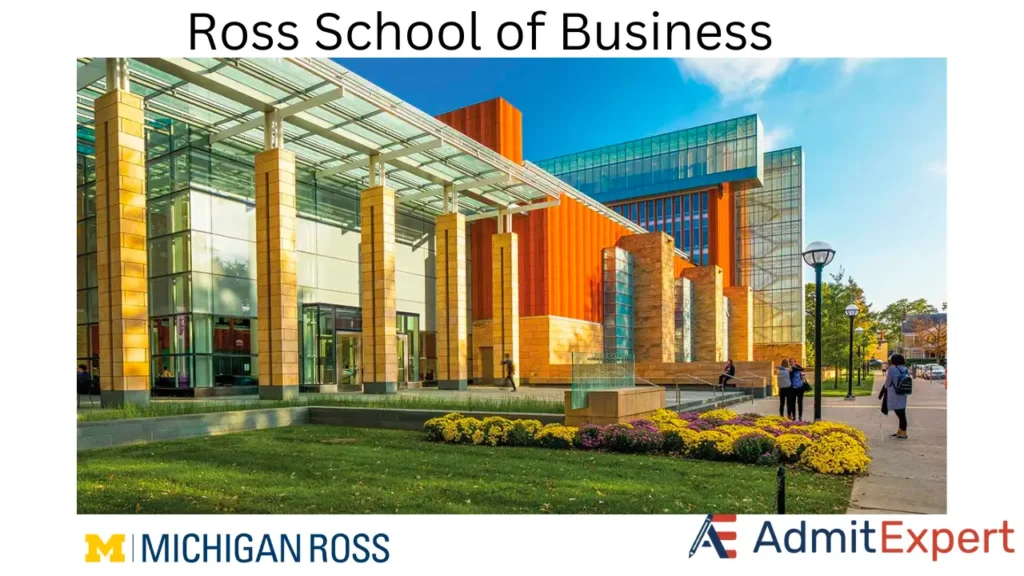
Michigan Ross MBA at a Glance
| Metric | Latest official figure |
|---|---|
| Latest complete class profile | MBA Class of 2027 |
| Class size | 379 |
| Women | 39% |
| International students | 40% |
| First-generation college students | 22% |
| Average work experience | 5.8 years |
| Average undergraduate GPA | 3.43 |
| Average current GMAT | 681 |
| Average legacy GMAT | 731 |
| Average GRE | 163 Quantitative / 160 Verbal |
| MBA degree requirement | 57 credits |
| Required MAP experience | 7 weeks, full time |
| Class of 2025 median base salary | $170,000 |
| Job seekers receiving an offer within 3 months | 86.1% |
| Job seekers receiving an offer within 6 months | 91.7% |
| 2026–27 Michigan-resident tuition | $78,586 |
| 2026–27 nonresident / international tuition | $83,946 |
| Merit scholarship range | $10,000 to full tuition |
Michigan Ross's current Full-Time MBA class profile still publishes the Class of 2027, making it the latest complete official entering-class profile available.
Ross has students from the Class of 2028 already enrolled, but it has not yet replaced the public class-profile page with a complete Class of 2028 dataset.
What Makes the Michigan Ross MBA Distinctive?
Ross describes its action-based learning model through REAL experiences:
- REAL.START — build and test new ventures;
- REAL.ADVISE — work on real organizational problems;
- REAL.INVEST — manage real capital through student-run funds;
- REAL.LEAD — practice leadership in challenging team situations.
The required MAP experience sits at the center of this model, but students can build applied evidence in several different ways.
That gives Ross a useful advantage for career changers: you can choose the kind of experience that addresses the exact credibility gap in your resume.
MAP Is a Required Seven-Week Full-Time Experience
Ross's Multidisciplinary Action Projects course is required for every first-year Full-Time MBA student.
The structure is unusually intensive:
- seven weeks;
- full time;
- second half of the winter term;
- a real organizational challenge;
- a team of MBA classmates;
- faculty and MBA2 support.
Ross currently offers more than 75 project choices.
Why MAP matters more than a typical class project
MAP temporarily becomes the student's main academic commitment.
That means the experience can involve much deeper immersion than a side project completed alongside several unrelated classes.
Students may need to:
- define an ambiguous business problem;
- identify the relevant evidence;
- divide work across a team;
- challenge assumptions;
- communicate with a client;
- develop recommendations;
- defend those recommendations.
For a career changer, this can create recent evidence in a field where the pre-MBA resume is weak.
An engineer pursuing consulting can demonstrate structured client problem solving.
A consultant moving into operations can seek a project involving implementation.
An aspiring investor can choose work requiring market and business-model analysis.
The project's value comes from what you actually do, not from the sponsor's brand name.
MAP Happens Before the Summer Internship
Timing makes MAP especially valuable.
The project occupies the second half of the first-year winter term, immediately before students transition toward the summer internship.
That means the sequence can look like:
core business foundation → MAP → summer internship → second-year specialization
For career changers, that progression is strategically useful.
The internship is often the first formal opportunity to demonstrate the new professional identity to an employer.
MAP can give the student a relevant story before that internship begins.
The Ross MBA Requires 57 Credits
The current Full-Time MBA curriculum requires 57 credits.
Students develop a general-management foundation through courses in areas such as:
- accounting;
- economics;
- finance;
- marketing;
- statistics and analytics;
- strategy;
- operations;
- leadership and organizational behavior.
Ross also requires:
- Competing in the Global Business Environment;
- a Business Law competency;
- MAP;
- additional elective coursework.
Students may count up to 10 of the required 57 credits from other University of Michigan schools, subject to program rules.
The university-wide flexibility matters when it solves a real gap
A broad university is valuable only when the student knows what they need from it.
A healthcare candidate might combine Ross with relevant health-policy or medical-system coursework.
A sustainability candidate may use environmental or public-policy resources.
A technology applicant may take technical or information courses outside Ross.
The useful application argument is not:
"Michigan has many schools."
It is:
"This is the business capability I need, this is the complementary expertise I need outside Ross, and this is how the combination supports my target role."
The AI Concentration Is a Defined 12-Credit Path
Ross now offers a formal Artificial Intelligence concentration.
Students complete at least 12 credits of approved AI-related electives, including:
- at least 4.5 credits of primary AI courses;
- up to 7.5 credits of vertical AI courses.
Current primary options include courses such as:
- AI and Strategy;
- Empowering Business Decision Making with Generative AI;
- AI for Business;
- Customer-AI Value Creation;
- applied data-analysis coursework.
The concentration fits inside the normal 57-credit MBA requirement.
An AI concentration should solve a management problem
The relevant question is not whether AI is important.
It is what you want to become capable of doing with it.
Examples might include:
- evaluating an AI-enabled product;
- redesigning a workflow;
- identifying where automation creates economic value;
- managing AI adoption;
- assessing governance and ethical risk;
- translating technical capability into strategy.
The concentration is a management pathway, not a substitute for a computer-science degree.
Ross's STEM Designation Requires the Management Science Specialization
This distinction is important.
The standard Ross MBA is not automatically STEM-designated for every student.
Students can complete the STEM-designated Specialization in Management Science.
The specialization requires:
- 14 credits of approved coursework;
- at least 10 foundational credits from the designated list.
It fits within the 57-credit MBA.
Eligible international students who complete the specialization and meet current immigration requirements may qualify to apply for the 24-month STEM OPT extension after standard post-completion OPT.
The AI concentration and STEM specialization are different
A student can be interested in AI without assuming that the AI concentration itself is the STEM pathway.
The academic labels solve different problems:
- AI concentration: structured depth in applying AI to business;
- Management Science specialization: the designated STEM academic pathway.
International candidates should plan the required coursework early enough to make sure the STEM specialization fits alongside other academic priorities.
Ross Offers More Than One Form of Action-Based Learning
MAP is required, but Ross also offers other applied experiences.
Students can gain hands-on experience through opportunities such as:
- student-run investment funds;
- Living Business Leadership Experience;
- entrepreneurship and venture development;
- impact projects;
- consulting-style engagements.
The best experience depends on what the resume is missing.
For consulting
The gap may be:
- client problem solving;
- executive communication;
- structured analysis.
For investing
The gap may be:
- sourcing;
- diligence;
- valuation;
- defending an investment thesis.
For general management
The gap may be:
- cross-functional execution;
- decision ownership;
- leading through ambiguity.
Applied learning becomes strategically useful when it creates evidence an employer will recognize.
Michigan Ross MBA Class Profile 2027
The current profile contains 379 students.
Class Composition
| Metric | Class of 2027 |
|---|---|
| Class size | 379 |
| Women | 39% |
| International students | 40% |
| Countries represented | 32 |
| U.S. states represented | 31 |
| First-generation college students | 22% |
| Students with advanced degrees | 15% |
| Dual-degree students | 9% |
| Average work experience | 5.8 years |
Ross also reports that 15% of domestic students are U.S. military veterans.
That denominator matters.
It should not be rewritten as 15% of the entire class.
Undergraduate Backgrounds
| Undergraduate area | Share |
|---|---|
| Business & Economics | 37% |
| Social Sciences & Humanities | 22% |
| Engineering | 20% |
| Computer Science | 7% |
| Other | 14% |
Business and economics form the largest group at 37%.
But almost two-thirds of the class studied something else.
That is useful context for applicants who assume an MBA class is mainly populated by undergraduate business majors.
The broader mix can also strengthen the action-learning environment because students bring different ways of thinking about the same problem.
Pre-MBA Industry Background
| Pre-MBA industry | Share |
|---|---|
| Finance | 17% |
| Consulting | 16% |
| Education / Nonprofit / Government | 9% |
| Technology | 8% |
| Health | 7% |
| Military | 7% |
| Engineering / Manufacturing | 6% |
| Energy / Sustainability | 6% |
| Media / Hospitality / Sports | 4% |
| Other | 20% |
No single pre-MBA industry dominates the class.
Finance is largest at 17%, followed closely by consulting at 16%.
That means Ross is not simply assembling a class from two or three standard MBA feeder industries.
Less familiar backgrounds need translation, not apology
An applicant from:
- government;
- military service;
- education;
- manufacturing;
- healthcare;
- energy;
- another specialized sector
should make the scale and complexity of the work easy to understand.
Explain:
- what decisions you owned;
- who depended on your work;
- what constraints you faced;
- how your responsibility grew;
- what changed because of you.
An unusual background becomes valuable when the admissions reader can understand its significance.
Michigan Ross GMAT, GRE, and GPA
Ross reports averages alongside middle-80% ranges.
| Measure | Average | Middle 80% |
|---|---|---|
| Current GMAT | 681 | 635–725 |
| Legacy GMAT | 731 | 700–770 |
| GRE Quantitative | 163 | 155–170 |
| GRE Verbal | 160 | 154–166 |
| Undergraduate GPA | 3.43 | 3.00–3.84 |
Average is not the same as median
Ross labels these figures as averages.
They should not be rewritten as medians simply because another school reports its profile that way.
Likewise, the middle-80% range does not represent an admissions cutoff.
Approximately 80% of reported values fall inside the interval; some enrolled students are above it and some below it.
Current GMAT and Legacy GMAT Use Different Scales
Ross reports:
- 681 average current GMAT;
- 731 average legacy GMAT.
Those two raw scores should not be compared directly.
The current exam and previous GMAT use different score scales.
A current applicant should benchmark against the current exam rather than treating older "730 GMAT" advice as a raw-score target.
Work Experience: 5.8 Years Is a Benchmark, Not a Requirement
The current class averages 5.8 years of work experience.
That is descriptive.
The admissions committee does not evaluate professional development by counting months alone.
The better questions are:
- Did your responsibility increase?
- Did you make meaningful decisions?
- Did you lead or influence people?
- Did you create measurable impact?
- Do you understand what the MBA needs to add now?
Michigan Ross MBA Application Requirements 2026–27
Ross's current application requirements give applicants two different ways to demonstrate quantitative readiness:
- submit an accepted standardized test;
- submit a Statement of Quantitative Academic Readiness.
This is more flexible than a conventional "test required or waiver approved" process.
Option 1: GMAT, GRE, or Executive Assessment
Ross accepts:
- GMAT;
- GRE;
- Executive Assessment.
Applicants may self-report scores initially and provide official reports after admission.
If an applicant has multiple scores, Ross uses the highest total score and its corresponding section scores rather than mixing subscores from different test dates.
Option 2: Statement of Quantitative Academic Readiness
Applicants can instead submit a Statement of Quantitative Academic Readiness inside the application.
No separate waiver request or pre-approval is required.
Ross says relevant evidence can include:
- quantitatively rigorous professional work;
- advanced analytical or STEM degrees;
- strong quantitative university coursework;
- certifications such as CPA or CFA;
- active MCAT, LSAT, PCAT, DAT, or OAT scores.
The applicant submits:
the standardized-test route or the quantitative-readiness statement route — not both
When does the statement make sense?
The statement can be a strong route when the application already contains convincing evidence of analytical readiness.
For example:
- engineering work using quantitative modeling;
- data-analysis responsibilities;
- corporate finance;
- a technical graduate degree;
- strong calculus, statistics, economics, or finance grades.
It is weaker when it simply says:
"My job involves numbers."
The evidence needs to show the level of quantitative reasoning and the decisions it supports.
A strong test score can still be the clearer option for someone whose academic record needs additional reinforcement.
Ross's Current Essays
The 2026–27 application contains two required written components.
Part 1: Career Aspirations — 300 words
Ross asks applicants to explain:
- the short-term career goal;
- how the Ross MBA and its program offerings will be used in that first post-MBA role.
The strongest response connects:
target role → missing capabilities → Ross resources → first post-MBA application
A generic list of classes and clubs is much less useful.
Part 2: Impact and Growth — 200 words
Applicants choose one of three prompts:
- a time something important did not go as planned and what happened next;
- a long-term effort of more than six months that produced a positive result and what sustained the commitment;
- a situation where the applicant created positive impact for a community or individual.
The prompts test different dimensions of the person behind the resume:
- resilience;
- sustained effort;
- contribution.
Choose the story that adds the strongest new evidence rather than the one that sounds most dramatic.
For prompt-specific strategy, see our Michigan Ross MBA essay analysis.
Ross Requires One Recommendation
Michigan Ross uses the GMAC Common Recommendation Form and requires one recommendation.
The school prefers someone who can discuss:
- professional performance;
- work style;
- comparative strength;
- constructive feedback;
- response to feedback.
A current or former supervisor is ideal, but Ross also accepts relevant alternatives such as:
- client;
- project manager;
- professional mentor.
The strongest recommender is the person with direct evidence.
Seniority is useful only when it comes with real knowledge of the applicant's work.
The Application Fee Is $250—but Ross Has Broad Waiver Criteria
The standard application fee is $250.
Ross currently waives the fee for several eligible categories, including:
- active U.S. military members and veterans;
- certain service organizations;
- current University of Michigan graduate students;
- eligible applicants from UN-designated least-developed countries;
- Fulbright Scholars;
- qualifying reapplicants;
- applicants who register for and attend at least one Ross Full-Time MBA admissions event before submitting.
Applicants should confirm eligibility in the current application rather than assuming a waiver applies automatically.
Ross MBA Interviews Are Invitation-Only
Interviews are conducted by:
- a Ross alum;
- or a current MBA student.
The interview is designed to help Ross understand how the applicant communicates professional experiences and accomplishments.
That means preparation should focus on stories rather than slogans.
Know examples involving:
- career progression;
- leadership;
- collaboration;
- conflict;
- failure;
- impact;
- career goals;
- why Ross.
The school explicitly emphasizes how applicants work with others, so the interview should show both individual accomplishment and collaborative behavior.
Michigan Ross MBA Application Deadlines 2026–27
| Round | Application deadline | Decision release |
|---|---|---|
| Round 1 | September 8, 2026 | December 11, 2026 |
| Round 2 | January 4, 2027 | March 19, 2027 |
| Round 3 | March 29, 2027 | May 14, 2027 |
Applications are due by 11:59 p.m. Eastern Time.
As of September 28, 2026, Round 1 has passed.
The next deadline is:
Round 2 — January 4, 2027
Ross states that it evaluates application rounds equally and recommends applying when the application is strongest.
The school also says admitted applicants are reviewed for merit scholarships regardless of the application round.
International Applicants Can Apply in Any Round
Ross allows international candidates to apply in all three rounds.
However, the school advises applicants who expect longer visa processing to consider applying earlier.
That is a logistical consideration rather than an admissions preference.
Ross Deferred MBA Allows Three to Five Years of Work First
Eligible graduating students can apply through the Ross Deferred MBA pathway.
Admitted students gain approximately three to five years of professional experience before returning for the Full-Time MBA.
The value of deferred admission comes from what the candidate does during those years.
The best plan identifies the experience that should exist before the MBA:
- leadership;
- industry expertise;
- operational responsibility;
- technical depth;
- entrepreneurial work.
Michigan Ross MBA Employment Report: Class of 2025
Ross's latest Full-Time MBA employment data shows a job market where outcomes continued to improve materially after graduation.
Offer and Acceptance Timing
| Reporting point | Job seekers receiving an offer | Job seekers accepting an offer |
|---|---|---|
| By graduation | 77.9% | 76.1% |
| Within 3 months | 86.1% | 84.3% |
| Within 6 months | 91.7% | 90.0% |
This table demonstrates why the reporting window matters.
A headline of approximately 92% receiving offers refers to the six-month mark.
The three-month figure is 86.1%.
Comparing Ross's six-month rate with another school's three-month rate would therefore create a false apples-to-apples comparison.
International Job Seekers Had Lower Three-Month Outcomes
Ross also reports employment timing by work-authorization group.
Offers within three months
- U.S. citizen / permanent resident: 89.7%
- foreign national: 81.6%
Acceptances within three months
- U.S. citizen / permanent resident: 87.7%
- foreign national: 80.0%
By six months, the gaps narrowed but did not disappear:
- offers: 95.0% vs. 87.5%;
- acceptances: 93.2% vs. 85.9%.
These are one class's outcomes, not a prediction of what every international student will experience.
They are still useful for financial planning because they demonstrate that recruiting can take longer for candidates with work-authorization constraints.
Michigan Ross MBA Salary
| Compensation metric | Class of 2025 |
|---|---|
| Mean base salary | $159,272 |
| Median base salary | $170,000 |
| Median signing bonus | $30,000 |
| Accepted offers reporting a signing bonus | 91% |
Mean and median are different.
Ross's mean base salary is $159,272.
The median is $170,000.
An article describing $170,000 as the "average Ross MBA salary" would therefore be inaccurate.
Do Not Treat the $197,000 "Salary Package" as Individual Median Total Compensation
Ross's career site also displays a $197,000 median salary package.
The school explicitly calculates that figure as:
median salary + (share receiving bonus × median bonus)
Using the current numbers:
$170,000 + (91% × $30,000) = $197,300, displayed approximately as $197,000
That is a useful summary estimate.
It is not the median of individually reported total compensation packages.
Applicants comparing schools should therefore keep the underlying components separate.
Employment by Industry
| Industry | Share of accepted jobs | Median base salary |
|---|---|---|
| Consulting | 33.5% | $190,000 |
| Financial Services | 19.5% | $175,000 |
| Technology | 13.1% | $143,000 |
| Healthcare | 10.2% | $138,500 |
| Consumer Packaged Goods | 8.9% | $125,000 |
| Manufacturing | 3.8% | $142,500 |
| Energy | 2.6% | $156,000 |
| Retail | 2.1% | $130,000 |
| Other | 6.4% | $136,000 |
Consulting, financial services, and technology together account for 66.1% of accepted jobs.
That is a large majority, but it also leaves more than one-third of placements elsewhere.
Healthcare and consumer packaged goods are especially visible relative to many MBA employment reports.
Consulting Is Ross's Largest Industry Destination
Consulting represents 33.5% of industry placements and 36.9% of functions.
The median consulting base salary is $190,000.
Ross also offers career-specific FACT groups—Functional Accountability Career Teams—supported by second-year peer coaches.
For consulting candidates, that can make:
- case preparation;
- recruiting accountability;
- employer research
more structured.
The MBA still does not guarantee consulting access.
Applicants need to evaluate:
- office preferences;
- visa sponsorship;
- prior experience;
- case-interview performance;
- internship recruiting.
Finance Is a Significant but Diverse Career Market
Financial services represents 19.5% of industry placements.
Finance as a function accounts for 17.8% of accepted roles.
The function breakdown is more useful than the broad label:
| Finance function | Share of all accepted jobs | Median base salary |
|---|---|---|
| Investment Banking | 11.9% | $175,000 |
| Corporate Finance | 3.0% | $130,000 |
| Private Equity / Venture Capital | 1.7% | $175,000 |
Investment banking is the clearly largest finance pathway.
That matters because banking has a relatively structured MBA recruiting process.
PE and VC are much smaller and typically depend more on:
- prior transaction experience;
- investing experience;
- sector credibility;
- independent networking.
Technology Is Meaningful but Not Ross's Only Non-Consulting Route
Technology represents 13.1% of industry placements.
The median base salary is $143,000, and the median signing bonus is $41,000.
A technology applicant should still define the function.
"Technology" can mean:
- product;
- strategy;
- operations;
- finance;
- marketing;
- business development.
The industry percentage does not reveal how many graduates entered any one of those roles.
Brand and Product Management Is a Large Functional Category
Ross's employment data groups Brand/Product Management under Marketing/Sales.
That subcategory alone accounts for 14.0% of accepted jobs.
Its median base salary is $127,500.
That is highly relevant for applicants pursuing:
- consumer brands;
- product management;
- go-to-market roles.
It is also a good example of why industry and function should be analyzed separately.
A product manager can work in:
- technology;
- consumer products;
- healthcare;
- another industry.
General Management Is One of Ross's Largest Functions
General management represents 19.1% of accepted roles.
That is larger than finance as a function.
The median general-management base salary is $140,000.
For candidates interested in:
- rotational leadership programs;
- operating roles;
- cross-functional management;
- long-term P&L responsibility
that number makes Ross's career profile broader than a simple consulting-and-finance narrative.
School-Facilitated Recruiting Was Involved in 81% of Accepted Jobs
Ross reports that 81% of accepted offers were obtained through school-facilitated recruiting activities.
That is one of the most decision-useful figures in the employment report.
The value of an MBA career system is not simply whether a company has hired from the school before.
It is whether the institution creates access through:
- recruiting events;
- job postings;
- internships;
- career advisers;
- alumni;
- peer coaching;
- structured employer relationships.
The 81% figure shows that those channels were involved in a large majority of accepted Class of 2025 offers.
Ross Reports 95% of Graduates as Career Switchers
Ross's current career page describes 95% of graduates as career switchers.
Career change can mean different things:
- switching industry;
- switching function;
- changing both;
- moving to a new geography.
That figure should not be interpreted as evidence that every transition is equally easy.
A consultant moving into corporate strategy faces a different recruiting problem from an engineer trying to enter private equity.
But it does reinforce the central role the MBA plays in professional transition.
Where Michigan Ross MBA Graduates Work
| Region | Share of reported placements |
|---|---|
| Midwest | 36.9% |
| Northeast | 22.0% |
| West | 20.3% |
| South | 6.8% |
| Southwest | 5.9% |
| Mid-Atlantic | 5.1% |
| International | 3.0% |
The Midwest is the largest region, but it does not dominate the class.
The Northeast and West together account for another 42.3% of placements.
Major metro destinations
Selected metro figures include:
- Chicago: 19.5%
- New York / New Jersey / Connecticut: 16.1%
- Detroit: 10.6%
- San Francisco Bay Area: 10.6%
- Seattle: 5.5%
Ross's career page summarizes this by noting that 67% of accepted offers were on the East Coast, West Coast, or in Chicago.
That supports a more accurate description of Ross:
strong Midwest roots with broad national placement
rather than:
primarily a regional MBA.
Recent Industry Movement Should Not Be Mistaken for a Permanent Trend
Ross's official 2024 and 2025 reports show:
| Industry | Class of 2024 | Class of 2025 |
|---|---|---|
| Consulting | 36.0% | 33.5% |
| Financial Services | 17.6% | 19.5% |
| Technology | 15.1% | 13.1% |
Consulting and technology declined as shares, while finance increased.
That is a real one-year change.
It does not establish why the shift occurred or prove what the next class will do.
Possible drivers could include:
- employer demand;
- student preferences;
- economic conditions;
- cohort composition.
The employment report establishes the outcome, not the cause.
Michigan Ross MBA Tuition and Cost of Attendance 2026–27
Ross publishes annual tuition plus separate financial-aid budget components.
Tuition
| Tuition category | 2026–27 annual tuition |
|---|---|
| Michigan resident | $78,586 |
| Non-Michigan resident / international | $83,946 |
The current tuition and financial-aid page states that 2027–28 tuition will be published in July 2027.
That means the incoming student's second-year tuition is not currently fixed.
Additional Published Budget Components
Ross lists the following fall/winter allowances for financial-aid planning:
| Expense | Published amount |
|---|---|
| Books and supplies | $2,000 |
| Food and housing | $22,276 |
| Personal expenses | $7,360 |
| Loan-fee allowance | $224 |
| Mandatory fees | $246.89 per full term |
Assuming two full academic terms, mandatory fees total $493.78.
Using those published components gives the following planning subtotal:
| Residency | Calculated subtotal |
|---|---|
| Michigan resident | $110,939.78 |
| Nonresident | $116,299.78 |
These are calculations from Ross's published components, not consolidated cost-of-attendance totals separately quoted by Ross.
International students have an additional services fee
Students in F or J visa status are charged an additional $500 per enrolled term.
For two full fall/winter terms, that would add $1,000.
That would bring the same planning calculation to approximately:
$117,299.78 before any other individual charges
for an international student paying nonresident tuition.
Ross's current page does not separately itemize a health-insurance premium in the budget components above, so students should confirm current coverage requirements and any additional cost directly with the university.
The Loan-Fee Allowance Is Not a Universal Expense
The $224 loan-fee figure is part of the financial-aid budget.
A student who does not use the relevant borrowing may not experience that amount as an actual out-of-pocket charge.
This is another reason to distinguish:
- financial-aid budget;
- actual personal spending.
The Current Budget Is Not the Full Two-Year MBA Cost
A realistic two-year financial model should include:
- 2026–27 tuition and current allowances;
- 2027–28 tuition once published;
- summer living costs;
- optional travel and activities;
- financing costs;
- foregone salary and benefits.
A summer internship can offset some cost.
The amount and timing should not be assumed before an internship offer exists.
Opportunity Cost Belongs in the MBA Calculation
Many Ross students leave well-paid careers in:
- finance;
- consulting;
- technology;
- healthcare;
- engineering.
A two-year MBA therefore costs more than tuition.
The financial model should include:
- salary not earned;
- bonuses not earned;
- retirement contributions lost;
- possible delayed promotions.
The $170,000 post-MBA median salary is useful context.
It is not a complete ROI calculation.
Michigan Ross Merit Scholarships
Every Full-Time MBA applicant is automatically considered for Ross merit scholarships.
No separate general merit application is required.
Awards range from:
$10,000 to full tuition
Ross considers factors including:
- academic ability;
- professional achievement;
- personal achievement;
- potential contribution to the community.
Scholarship recipients are notified at admission.
Dean's Impact Scholars Receive More Than Full Tuition
The Dean's Impact Scholars award includes:
- full tuition;
- an annual stipend supporting educational travel, leadership development, and other non-tuition expenses.
That makes it different from a standard full-tuition award.
It is also highly selective.
Applicants should not build a financing plan around receiving it.
Dean's Fellows Receive Full Tuition
Students selected as Dean's Fellows receive full-tuition scholarships.
The program also includes access to alumni senior leaders and connections with other fellows and faculty.
Again, full tuition does not automatically mean every living expense is covered.
The award letter defines what is actually funded.
Fellowship Labels and Scholarship Dollars Are Not Always Additive
Ross describes Forté, Consortium, and Reaching Out MBA fellowships as distinctions connected to scholarship funding and professional development.
These designations should not automatically be counted as an additional scholarship on top of an existing merit award.
For example:
- Consortium admits are evaluated for Ross merit funding up to full tuition;
- ROMBA Fellows receive at least $20,000 under the current program structure;
- other fellowship designations can be attached to merit support.
The financing comparison should use confirmed dollars, not the number of award names.
Health Innovation Scholars Is Not Automatically Full Tuition
The current Health Innovation Scholars program offers:
- tailored healthcare programming;
- alumni access;
- professional-development support;
- potential scholarship funding.
Applicants who list healthcare as a career interest are considered.
The official description does not state that every Health Innovation Scholar automatically receives full tuition.
That distinction matters when building a financing plan.
Additional Funding Can Become Available After Enrollment
Ross lists several opportunities for current students, including:
- second-year community-impact awards;
- entrepreneurship scholarships through Zell Lurie;
- Consortium-related second-year awards;
- impact-focused scholarships;
- need-linked awards.
These opportunities can be valuable.
They should not be treated as money already available when deciding whether to enroll.
Impact Advantage Supports Some Social-Impact Careers
Ross's current financing page describes the Impact Advantage Student Loan Repayment Program as providing up to $37,500 in loan support to eligible Full-Time MBA alumni pursuing qualifying work in:
- education;
- government;
- nonprofit sectors
during the first five years after graduation.
The same page currently notes that the application is closed.
Prospective students should therefore treat it as a current program feature to monitor, not guaranteed future funding.
Is Michigan Ross a Good MBA for Consulting?
Yes.
Consulting is the largest Class of 2025 industry destination at 33.5%, and consulting functions account for 36.9% of accepted roles.
The median consulting base salary is $190,000.
Ross also offers:
- FACT peer recruiting groups;
- major consulting employers;
- MAP;
- case-preparation support;
- structured career coaching.
For career changers, consulting can provide a comparatively standardized internship route.
Is Michigan Ross a Good MBA for Finance?
Yes.
Financial services represents 19.5% of industries.
Investment banking alone accounts for 11.9% of accepted functions.
Ross also offers:
- investment-banking recruiting support;
- student investment funds;
- finance coursework;
- New York finance treks;
- fintech resources.
Applicants targeting PE or VC should still distinguish those paths from the much larger investment-banking market.
Is Michigan Ross a Good MBA for Technology?
Technology represents 13.1% of current industry placements.
Ross also offers:
- AI concentration;
- Management Science specialization;
- Business+Tech resources;
- technology FACT groups;
- relevant electives.
But "technology" is not one career.
Applicants need to define whether they want:
- product;
- strategy;
- finance;
- marketing;
- operations;
- business development.
Is Ross Strong for Product and Brand Management?
Ross's current function data makes this more visible than the technology-industry percentage alone.
Brand/Product Management accounts for 14.0% of accepted roles within the Marketing/Sales function.
That is a meaningful pipeline.
It is particularly relevant for candidates targeting:
- consumer products;
- technology product roles;
- brand management;
- go-to-market positions.
Is Ross Strong for Healthcare?
Healthcare represents:
- 7% of the current entering class's pre-MBA backgrounds;
- 10.2% of Class of 2025 industry placements.
Those numbers come from different cohorts and should not be treated as a direct conversion statistic.
Ross's healthcare ecosystem also includes:
- Health Innovation Scholars;
- healthcare concentration options;
- University of Michigan health resources;
- industry recruiting.
For a healthcare applicant, the right question is whether the program supports the specific part of healthcare they want to enter.
Who Should Consider Michigan Ross Most Seriously?
Ross deserves close consideration if you value:
- required action-based learning;
- MAP;
- consulting;
- finance;
- general management;
- brand and product management;
- healthcare;
- entrepreneurship;
- student-run investment funds;
- AI coursework;
- a customizable STEM pathway;
- access to the broader University of Michigan;
- a collaborative Ann Arbor MBA environment.
Applicants should think more carefully if they strongly prefer:
- a highly urban MBA experience;
- a program where experiential learning is largely optional;
- a whole-MBA STEM designation without additional course planning;
- or a very small cohort.
The strongest Ross fit is usually based on what you need to practice, not simply what you want to study.
How to Decide Whether Ross Fits Your MBA Goals
1. Define the post-MBA role
Specify:
- function;
- industry;
- geography;
- employer type.
2. Identify the evidence your resume currently lacks
Do you need proof of:
- client problem solving;
- investing judgment;
- product work;
- leadership;
- analytics;
- operations;
- cross-functional management?
3. Choose Ross experiences that create that evidence
Map the gap to:
- core courses;
- MAP;
- REAL experiences;
- electives;
- AI concentration;
- Management Science specialization;
- University of Michigan coursework;
- summer internship.
4. Read the employment data at the correct level
Do not use the 19.5% financial-services figure to justify a PE goal.
Do not use the 13.1% technology figure to justify product management.
Look at the specific function and subfield.
5. Model the full financial commitment
Include:
- resident status;
- tuition;
- published living allowances;
- international fees where applicable;
- scholarship;
- borrowing;
- summer costs;
- opportunity cost.
Michigan Ross MBA FAQs
What is the latest complete Ross MBA class profile?
The latest complete profile currently published by Ross is the Class of 2027, with 379 students.
What is the average GMAT at Michigan Ross?
The Class of 2027 reports:
- 681 average current GMAT
- 731 average legacy GMAT
The two exams use different score scales.
What is the average GRE at Ross?
Ross reports averages of:
- 163 Quantitative
- 160 Verbal
What is the average GPA at Ross?
The Class of 2027 reports an average undergraduate GPA of 3.43.
How much work experience do Ross MBA students have?
The current class averages 5.8 years of professional experience.
Can I apply without a GMAT, GRE, or Executive Assessment?
Yes. Applicants may submit a Statement of Quantitative Academic Readiness instead of a test score.
No separate pre-approval is required.
Can I submit both a test score and the quantitative-readiness statement?
No. Ross says applicants submit either a test score or the Statement of Quantitative Academic Readiness.
What are the current Ross MBA essays?
The 2026–27 application includes:
- a 300-word Career Aspirations essay;
- one 200-word Impact and Growth essay chosen from three prompts.
How many recommendations does Ross require?
Ross requires one recommendation.
How much is the Ross MBA application fee?
The standard application fee is $250, with several current waiver categories.
Is the Ross interview required?
Interviews are invitation-only and are conducted by a Ross alum or current MBA student.
What is the next Ross MBA deadline?
As of September 28, 2026, the next deadline is:
Round 2 — January 4, 2027 at 11:59 p.m. Eastern Time
Is the Michigan Ross MBA STEM-designated?
Not automatically for every MBA student.
Ross offers a STEM-designated Specialization in Management Science requiring 14 credits of approved coursework.
What is MAP?
MAP is the required seven-week, full-time first-year project experience where MBA teams work on real organizational challenges.
How much is Michigan Ross tuition?
For 2026–27:
- Michigan residents: $78,586
- nonresidents / international students: $83,946
Additional fees and living-cost allowances apply.
Does Ross automatically consider applicants for merit scholarships?
Yes. All admitted Full-Time MBA applicants are automatically reviewed for merit scholarships.
Awards range from $10,000 to full tuition.
Does Ross offer full-tuition scholarships?
Yes. Current full-tuition programs include Dean's Impact Scholars and Dean's Fellows.
What is the latest Ross MBA salary?
The Class of 2025 reports:
- $170,000 median base salary
- $159,272 mean base salary
- $30,000 median signing bonus
Is Ross's job-offer rate 86% or 92%?
Both are correct for different reporting windows:
- 86.1% within three months
- 91.7% within six months
among job seekers.
How did international graduates fare in the 2025 job market?
Among foreign-national job seekers:
- 81.6% received an offer within three months;
- 87.5% received one within six months.
These are one cohort's outcomes, not guarantees for future students.
Where do Ross MBA graduates work?
The Class of 2025 was geographically broad:
- Midwest: 36.9%
- Northeast: 22.0%
- West: 20.3%
Chicago, the New York tri-state area, Detroit, and the San Francisco Bay Area were all significant destinations.
Final Thoughts
Michigan Ross is strongest when action-based learning is treated as a career-development mechanism rather than a slogan.
Students build a general-management foundation.
Then every first-year MBA spends seven weeks working full time on a real business problem through MAP.
They can manage real investment capital, work on ventures, practice leadership, use the wider University of Michigan, and choose increasingly specialized coursework.
Ross has also expanded its academic options around AI while preserving a distinct, opt-in STEM pathway through the Management Science specialization.
The career data reinforces the value of that applied model.
Consulting remains the largest destination, but finance, general management, marketing and product roles, technology, healthcare, and consumer businesses are all meaningful. Eighty-one percent of accepted Class of 2025 offers came through school-facilitated recruiting activities, and Ross reports that 95% of graduates are career switchers.
The financial decision deserves the same level of precision.
Resident and nonresident tuition differ. Ross publishes living-cost components rather than one simple all-in price. International students face an additional services fee. Merit awards range from $10,000 to full tuition, while later scholarships should not be assumed before they are actually awarded.
The strongest reason to apply is therefore not:
"Ross is hands-on."
It is:
"This is the capability my current career has not allowed me to prove, and Ross's core curriculum, MAP, action-based experiences, recruiting system, and University of Michigan resources give me a concrete way to build and demonstrate it before I pursue my next role."
If Michigan Ross is on your target list, continue with our Michigan Ross MBA essay guide and MBA application deadlines tracker.
Related Articles

Deferred MBA Programs: 2027 Deadlines, Eligibility & Top Schools
Compare the leading deferred MBA programs for college seniors and eligible graduate students, including HBS 2+2, Stanford, Wharton, Booth, Kellogg, MIT Sloan, Columbia, Haas and Darden, with current 2027 deadlines and rules.
Read Article →
M7 Business Schools: 2026–2027 Guide to Rankings, Admissions, Costs & Careers
A current comparison of Harvard, Stanford, Wharton, Chicago Booth, Kellogg, MIT Sloan and Columbia covering 2026 rankings, Class of 2027 profiles, GMAT/GRE scores, 2027 application deadlines, MBA costs and Class of 2025 career outcomes.
Read Article →
Stanford GSB MBA Guide 2026–27: Admissions, Class Profile, Curriculum, Employment, Fees & Scholarships
A complete guide to the Stanford Graduate School of Business MBA covering admissions, the latest class profile, GMAT and GRE scores, curriculum, application deadlines, employment outcomes, tuition, cost of attendance, scholarships, and financial aid.
Read Article →