

National University of Singapore (NUS) MBA Guide 2026–27: Admissions, Class Profile, Curriculum, Employment, Fees & Scholarships
A complete guide to the NUS MBA, covering its flexible 12–17 month structure, current class profile, August 2027 admissions, curriculum, career outcomes, fees, scholarships, and applicant fit.
The NUS MBA is easy to describe superficially.
It is a globally oriented MBA in Singapore, taught in one of Asia's most connected business hubs, with an international student body and strong exposure to the region.
But "I want an MBA in Asia" is not a career plan.
The more useful question is:
"Can the NUS MBA give me the academic preparation, practical evidence, regional network, and recruiting access required for the specific transition I want?"
That question matters because NUS gives full-time students an unusual amount of control over time.
The program is designed around a 17-month full-time pathway, but students can fast-track and finish in as little as 12 months, depending on course planning and availability.
That flexibility can materially change the MBA's value.
A student returning to a sponsoring employer may prioritize speed and a shorter period without salary.
A candidate trying to change:
- function;
- industry;
- country;
may benefit much more from the longer pathway because it creates room for:
- a summer internship;
- additional electives;
- international exchange;
- deeper networking;
- more recruiting time.
The curriculum is similarly flexible.
NUS currently structures the MBA around 17 courses:
- seven academic core courses;
- three experiential core courses;
- seven electives.
Students can use those electives to build one or two optional specialisations, while Real Estate and Healthcare Management follow more structured routes that need to be indicated at application.
The career story also needs careful interpretation.
The current NUS career page reports that 93% of the Class of 2024 received at least one job offer within three months of graduation, with an average post-MBA salary of US$88,002.
A separate August 2026 NUS MBA brochure publishes another career-impact dataset showing:
- 58% of post-MBA job locations in Singapore;
- 73% changing function;
- 63% changing industry;
- 52% changing location.
Those figures are useful, but the brochure does not label them as the same Class of 2024 employment table. They should therefore remain a separate current program-level career dataset rather than being merged into one cohort.
This guide focuses on the full-time NUS MBA. It uses the current typical full-time class profile, the August 2027 intake admissions cycle, NUS's current program structure, its latest class-specific career highlights, the August 2026 MBA brochure, and the current tuition and scholarship information.
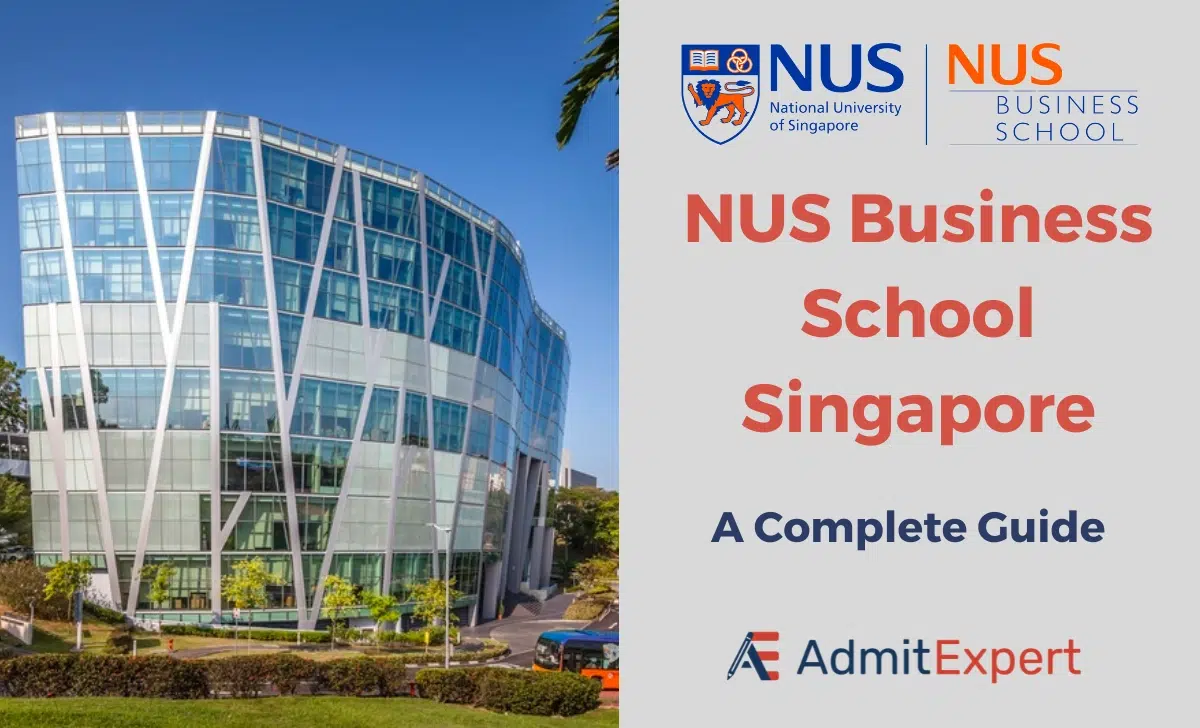
NUS MBA at a Glance
| Metric | Latest official information |
|---|---|
| University | National University of Singapore |
| School | NUS Business School |
| Location | Singapore |
| Main intake | August |
| Full-time duration | 12–17 months |
| Standard full-time design | 17 months, with option to accelerate to 12 months |
| Full-time curriculum | 17 courses |
| Academic core | 7 courses |
| Experiential core | 3 courses |
| Electives | 7 courses / 28 elective units |
| Typical full-time class size | 120 |
| Average age | 29 |
| Average work experience | 6 years |
| Women | 43% |
| International students | 92% |
| Typical nationalities represented | 21 in the published profile table |
| Average legacy GMAT | 670 |
| Average current GMAT | 615 |
| Average GRE | 157 Verbal / 165 Quantitative |
| Class of 2024 offer rate | 93% received at least one offer within 3 months |
| Class of 2024 average post-MBA salary | US$88,002 |
| August 2027 published tuition / payment total | S$106,849.76 |
| Application fee | S$100 |
| Next full-time deadline | Round 1 — October 29, 2026 |
The current NUS MBA class-profile page labels its numerical table as a Typical Class Profile.
That is the safest way to use those figures.
NUS's August 2026 brochure uses the same principal full-time profile numbers in a graphic labeled "Meet the class of 2026," but the live website continues to frame the data as typical rather than as a current admissions class report.
For applicant comparisons, the live profile's methodology should therefore remain visible.
What Makes the NUS MBA Distinctive?
Several features reinforce one another:
- a full-time timeline that can range from 12 to 17 months;
- a heavily international class based in Singapore;
- an academic core paired with an experiential core;
- a substantial consulting project built into the degree;
- nine optional specialisations;
- internships, global immersion, exchanges, and cross-faculty opportunities;
- a career ecosystem centered on Asia but extending beyond Singapore.
The strongest NUS fit is usually not simply:
"I want international exposure."
A more useful plan might be:
"I want to move from engineering into regional technology strategy, I need stronger commercial judgment and client-facing evidence, and I can use the Digital Business pathway, Consulting Project, internship, and Singapore employer network to build that credibility."
The degree becomes easier to evaluate once each program feature has a specific role in the transition.
Singapore Is Most Valuable When the Career Goal Is Region-Specific
Singapore is one of Asia's major corporate and financial hubs.
NUS's current career materials emphasize access to:
- multinational companies;
- regional headquarters;
- startups;
- consulting firms;
- financial institutions;
- technology companies;
- healthcare;
- real estate;
- consumer businesses.
But location does not guarantee access to every Asian market.
A candidate targeting Singapore-based strategy needs a different network from someone planning to return to:
- India;
- Japan;
- Indonesia;
- Vietnam;
- Europe;
- North America.
NUS becomes most useful when the applicant can explain which part of the regional ecosystem matters.
NUS Is Highly International—but International Classroom Diversity Is Not an Employment Outcome
The current typical full-time profile reports:
92% international students
That makes cross-cultural peer learning one of the clearest features of the program.
But classroom nationality and post-MBA work location are different measures.
An international candidate who wants to remain in Singapore should separately investigate:
- employer demand;
- work authorization;
- target-industry hiring;
- role seniority;
- salary expectations;
- recruiting timelines.
A 92% international class does not mean 92% of international graduates remain in Singapore.
The Current Career-Impact Geography Is Strongly Singapore-Centered
NUS's August 2026 MBA brochure publishes the following post-MBA job-location distribution:
| Post-MBA location | Share |
|---|---|
| Singapore | 58% |
| Southeast Asia | 11% |
| East Asia | 9% |
| China / Greater China | 6% |
| South Asia | 5% |
| North America | 5% |
| Central Asia / Middle East | 3% |
| UK / Europe | 2% |
| Asia-Pacific, other | 1% |
The brochure does not attach this location table to the Class of 2024 career page's employment denominator.
It is therefore best read as current program-level career-impact evidence.
The central conclusion is still clear:
Singapore is the largest single post-MBA destination in NUS's current career materials.
The Geographic Concentration Can Be an Advantage or a Constraint
For an applicant targeting:
- Singapore;
- Southeast Asia;
- broader Asia-Pacific roles;
the location density can be a major advantage.
For someone committed to:
- New York;
- London;
- another distant market;
the relevant question becomes more specific:
"Which NUS employers and alumni actively recruit into my target geography?"
A globally known MBA does not make recruiting friction identical across countries.
Full-Time NUS MBA: 12 Months or 17 Months?
NUS currently publishes a 12–17 month full-time format.
The standard timeline shown in the August 2026 brochure is 17 months, with an option to finish in 12 months.
The NUS MBA FAQ says accelerated completion depends on:
- course planning;
- course availability;
- coordination with the Program Management team.
That means 12 months is a real option.
It is not simply a promise that every preferred elective, internship, exchange, and specialisation can always be compressed into one year.
The 17-Month Route Creates More Space for Career Exploration
The current full-time program timeline includes:
- Semester 1 — August to November;
- Semester 2 — January to April;
- Special Terms — May to July;
- a later Semester 1 period for students following the longer route.
The Special Term can be used for:
- summer internship;
- short exchange;
- additional electives.
The later term can support:
- more electives;
- part-time or unit-bearing internship;
- short or semester exchange.
That additional time is not automatically valuable.
It is valuable when those experiences solve a career problem.
The 12-Month Route Can Reduce Opportunity Cost
Finishing faster can reduce:
- time away from full-time salary;
- rent and living exposure;
- career interruption.
That can be attractive to someone who:
- already knows the target role;
- is returning to a sponsor;
- needs the MBA mainly for acceleration;
- does not need a summer internship to become credible.
The trade-off is fewer months for optional experiences and recruiting.
A Major Career Pivot Often Favors More Time
A candidate simultaneously changing:
- country;
- function;
- industry
is asking employers to believe several new things at once.
A longer MBA timeline can provide more opportunities to create evidence through:
- consulting project;
- internship;
- exchange;
- mentorship;
- student leadership;
- electives.
That does not guarantee success.
It can make the transition more credible.
NUS Also Offers Part-Time and Part-Time Flex Formats
The full-time MBA is not the only NUS format.
NUS currently offers:
- Part-time MBA;
- Part-time Flex MBA.
Working professionals can complete the part-time degree over:
- 18;
- 24;
- or 30 months,
depending on pathway and planning.
Non-Singaporean or non-PR part-time applicants need the relevant Singapore-based employment or residency status at application.
This guide does not use part-time profile or career data as a proxy for the full-time program.
The MBA Requires 68 Units
NUS's current academic structure is equivalent to 68 units.
The program describes this as:
- seven academic core courses;
- three experiential core courses;
- seven electives.
Most courses are four units.
Students need 28 elective units if they do not follow a more structured Real Estate or Healthcare curriculum.
The Seven Academic Core Courses Build the Management Foundation
The current NUS MBA curriculum includes seven academic core courses:
- Corporate Strategy;
- Financial Management;
- Financial Accounting;
- Managerial Economics;
- Marketing Strategy;
- Managerial Operations & Analytics;
- Leading with Impact.
This is a conventional general-management foundation with a strong Asia-facing context.
The more distinctive element is what NUS places beside the academic core.
The Experiential Core Is Not an Optional Add-On
NUS currently identifies three experiential core components:
- Launch Your Transformation
- MBA Management Skills / MBA Toolkit
- MBA Consulting Project
That is important.
Experiential learning is not something a student must find entirely through clubs or optional projects.
It is embedded into the degree structure.
Launch Your Transformation Starts With Communication and Influence
Launch Your Transformation is a five-day intensive bootcamp at the start of the program.
It uses:
- role play;
- feedback;
- communication exercises;
- influence practice.
The goal is to build interpersonal and leadership capability before students enter the rest of the MBA.
That can be especially useful for applicants whose technical skills are already strong.
Their development need may be:
- influence;
- executive communication;
- self-awareness;
- leadership under pressure.
MBA Toolkit Builds Structured Problem-Solving Skills
The MBA Toolkit / Management Skills component focuses on practical consulting-style capabilities such as:
- hypothesis-led thinking;
- project planning;
- problem solving;
- gap analysis;
- value proposition development;
- recommendation delivery.
Those skills are useful beyond consulting.
A manager in:
- product;
- operations;
- finance;
- strategy
often needs to structure ambiguous problems and communicate a decision.
The MBA Consulting Project Runs for Three to Four Months
The MBA Consulting Project is one of the program's most important applied experiences.
NUS says the project runs for:
3–4 months
and involves approximately:
130 hours
of work.
Teams work directly with company stakeholders on a real business problem and develop recommendations spanning areas such as:
- finance;
- marketing;
- operations;
- strategy.
The Consulting Project Has Significant Scale
NUS says the project has delivered:
300+ projects
across:
12 industries
with:
150+ companies
That gives students access to a substantial history of client work.
The relevant applicant question is still:
"What problem would I want to learn how to solve?"
not:
"Which famous client might I get?"
The Best Consulting Project Is the One That Creates Missing Evidence
A career changer should ask what the project can prove.
Examples:
- client-facing ability;
- market research;
- commercial judgment;
- analytical rigor;
- cross-cultural communication;
- executive presentation;
- project management.
For a consultant, the project can create direct problem-solving evidence.
For a product candidate, it can create customer and business-model evidence.
For a finance candidate, it can create commercial or investment analysis.
NUS Offers Nine MBA Specialisations
The current program allows students to specialise in up to two areas:
- Finance;
- Marketing;
- Strategy & Organisation;
- Innovation & Entrepreneurship;
- Digital Business;
- Consulting;
- Analytics & Operations;
- Real Estate;
- Healthcare Management.
Specialisations are optional.
Students who want one generally need:
- at least 20 relevant units;
- a GPA of 3.5 in the relevant courses.
Real Estate and Healthcare Must Be Chosen at Application
Real Estate and Healthcare Management are different from the other specialisations.
NUS says applicants who want either route need to indicate that preference during the application process.
The academic structures are also more prescribed.
That means an applicant should not assume:
"I can decide in the second year to add Healthcare or Real Estate exactly like Consulting or Marketing."
These pathways need earlier planning.
Finance Covers More Than Banking
The Finance specialisation includes areas such as:
- international financial management;
- private equity;
- venture capital;
- portfolio management;
- wealth management;
- valuation;
- financial technology;
- risk.
Applicants should therefore distinguish among:
- investment banking;
- corporate finance;
- asset management;
- private equity;
- fintech.
A broad finance label is not enough to judge fit.
Consulting Is a Formal Academic Pathway
The Consulting specialisation focuses on:
- consulting industry structure;
- consulting best practices;
- analytical knowledge;
- problem solving;
- recommendation development.
It can complement the MBA Consulting Project and case-interview preparation.
A candidate pursuing consulting should still research:
- target firms;
- target offices;
- visa requirements;
- prior-experience expectations.
Digital Business Is More Than a Technology Label
The Digital Business specialisation includes exposure to:
- artificial intelligence;
- blockchain;
- cryptocurrency;
- machine learning;
- big data;
- digital transformation.
The objective is managerial.
Students learn to lead and manage businesses in environments shaped by these technologies.
That makes the path relevant to:
- product;
- strategy;
- operations;
- transformation;
- entrepreneurship.
Analytics & Operations Connects Insight With Execution
The Analytics & Operations specialisation explicitly links:
- analytical modeling;
- business insight;
- operational execution.
That combination matters because analysis without implementation has limited value.
A student can use the pathway for careers in:
- operations;
- supply chain;
- analytics;
- consulting;
- technology;
- general management.
Marketing Includes Product and Digital Work
The Marketing pathway includes topics such as:
- customer analysis;
- consumer behavior;
- product management;
- brand management;
- digital marketing;
- marketing analytics;
- pricing.
That makes it relevant to more than traditional brand management.
Applicants should specify whether they want:
- product marketing;
- growth;
- brand;
- customer analytics;
- digital strategy.
Innovation & Entrepreneurship Extends Into the Wider NUS Ecosystem
NUS offers entrepreneurship-oriented coursework and experiential opportunities such as:
- TechLaunch;
- NUS Overseas College;
- venture-capital coursework;
- entrepreneurship electives.
The university's broader innovation ecosystem can help students connect with:
- founders;
- researchers;
- technical talent;
- startups;
- investors.
That does not guarantee a successful company.
It increases the number of environments in which the student can test ideas.
NUS Overseas College Includes a Six-Month Startup Internship Immersion
NUS describes the NUS Overseas College opportunity as an intensive six-month internship immersion with startups in global locations.
That is a major experiential commitment.
A student considering it needs to think about:
- graduation timing;
- career goal;
- geography;
- academic schedule.
It can be highly valuable to a founder or startup-oriented student.
It is not simply another elective.
C-Suite Life Simulates Executive Decision-Making
NUS's experiential electives include C-Suite Life, an immersive role-play program.
Students enter simulated executive roles and deal with:
- changing information;
- business problems;
- stakeholder pressure;
- decision-making under uncertainty.
The value is different from a case discussion.
The student has to make decisions while the scenario is moving.
Healthcare Management Connects NUS Business With Public Health
The Healthcare Management specialisation is delivered with the NUS Saw Swee Hock School of Public Health.
The current structure includes healthcare-specific core courses and electives in areas such as:
- health economics;
- healthcare operations;
- public-health policy;
- quality of care;
- aging;
- clinical trials.
That makes it more specialized than simply taking one healthcare elective inside the MBA.
Real Estate Is Also a Structured Specialisation
The Real Estate pathway includes coursework in:
- real estate investment;
- real estate economics;
- development;
- finance;
- funds;
- valuation;
- data analytics;
- sustainable real estate.
Singapore's property and regional investment markets make this pathway particularly relevant to applicants targeting Asia-based real estate.
Again, the applicant needs to specify the function:
- investment;
- development;
- asset management;
- finance.
Global Immersion Adds Short International Exposure
NUS's Global Immersion Programme offers intensive overseas study trips.
Recent destinations listed by NUS include markets in:
- Europe;
- Middle East;
- South Asia;
- East Asia;
- Southeast Asia;
- Australia.
The most useful immersion is one connected to a real learning objective.
Travel itself is not a capability.
NUS Has Exchange Relationships With More Than 60 Schools
The NUS MBA FAQ says students can access exchange and overseas opportunities through partnerships with 60+ business schools.
The August 2026 brochure lists exchange partners across:
- North America;
- Europe;
- Asia;
- Oceania.
A semester exchange can be useful for a student trying to build a network outside Singapore.
It also consumes time and can add travel and living cost.
The Full-Time Program Can Include Internships
The 17-month program timeline explicitly provides room for:
- summer internship;
- part-time internship;
- unit-bearing internship.
That is important for career changers.
An internship can create:
- local employer experience;
- sector credibility;
- functional evidence;
- a potential full-time pathway.
The shorter 12-month route can reduce the time available for these experiences, so candidates who need an internship should plan duration carefully.
NUS MBA Typical Class Profile
The current class-profile page publishes the following full-time profile:
| Metric | Typical full-time profile |
|---|---|
| Students | 120 |
| Average age | 29 |
| Average work experience | 6 years |
| Women | 43% |
| International students | 92% |
| Nationalities | 21 |
| Industries | 24 |
| Average legacy GMAT | 670 |
| Average current GMAT | 615 |
| Average GRE Verbal | 157 |
| Average GRE Quantitative | 165 |
These are the school's current published benchmarks.
They should not be treated as minimum admission requirements.
Six Years of Work Experience Is a Class Average—Not the Eligibility Minimum
NUS requires at least:
two years of post-bachelor's full-time work experience at application
The typical class average is:
six years
Those numbers answer different questions.
Two years determines eligibility.
Six years describes the typical cohort.
A candidate at the lower end of the experience range should show:
- progression;
- responsibility;
- impact;
- maturity;
- why the MBA makes sense now.
The Class Is Extremely International
With 92% international students, the NUS MBA is much more globally mixed than many domestic MBA cohorts.
That can increase peer learning around:
- different markets;
- different management cultures;
- cross-border careers;
- international business.
The applicant still needs a clear contribution story.
Being from a particular country does not automatically establish what perspective you bring.
Current and Legacy GMAT Scores Must Stay Separate
NUS reports:
- 670 average legacy GMAT
- 615 average current GMAT
These scores come from different exam versions.
They should not be interpreted as a 55-point decline.
Applicants should compare their score with:
- the matching test version;
- current percentiles;
- the rest of the academic profile.
GRE Is Reported by Section
NUS reports:
- 157 average GRE Verbal;
- 165 average GRE Quantitative.
Adding the two into 322 would create a derived total the school does not publish in the current class-profile table.
The section scores should remain separate.
The August 2026 Brochure Adds Pre-MBA Industry Context
NUS's current brochure provides the following full-time pre-MBA industry mix:
| Pre-MBA industry | Share |
|---|---|
| Financial Services | 21% |
| Other | 17% |
| Technology | 16% |
| Manufacturing / Engineering / Transportation | 16% |
| Healthcare / Pharmaceutical | 7% |
| Consulting | 6% |
| Energy | 5% |
| Real Estate | 4% |
| Government / Public Sector | 3% |
| FMCG / Consumer Goods | 3% |
| Media & Entertainment | 2% |
The class therefore combines substantial experience in:
- finance;
- technology;
- engineering;
- healthcare;
- consulting;
- energy.
No single background is required.
Finance Is the Largest Single Incoming Industry
Financial services represents 21% of the brochure's full-time pre-MBA mix.
That does not mean finance applicants have an admissions advantage.
It means a substantial share of classmates bring finance experience into the classroom.
A finance applicant therefore needs to differentiate beyond the industry label.
Technology and Engineering Are Both Large Incoming Groups
Technology and manufacturing/engineering/transportation each represent 16%.
That is useful context for applicants interested in:
- digital business;
- product;
- operations;
- technology strategy;
- industrial transformation.
It also means a nontechnical applicant can expect many classmates with quantitative and technical backgrounds.
NUS MBA Admissions Requirements for August 2027
The current admissions page requires:
- bachelor's degree;
- at least two years of post-bachelor's full-time work experience;
- GMAT, GRE, or Executive Assessment unless a waiver is approved;
- one referee report;
- essays;
- application fee;
- English-language evidence where required;
- recorded video assessment;
- live interview if shortlisted.
The August 2027 cycle introduces broader use of the Executive Assessment across MBA formats.
GMAT, GRE, and Executive Assessment Are All Accepted
For the August 2027 intake, applicants across NUS MBA formats can submit:
- GMAT;
- GMAT Focus;
- GRE;
- Executive Assessment.
NUS considers test scores alongside:
- academic record;
- professional achievement;
- leadership;
- career trajectory;
- personal contribution.
No minimum GMAT, GRE, or EA score is published.
NUS Accepts Online GMAT and GRE Scores
The current FAQ says NUS accepts:
- in-person GMAT/GRE;
- online GMAT/GRE.
That differs from schools that require a test-center score.
Applicants should still ensure the score is valid for the required period at application.
Applicants With Four or More Years Can Be Considered for a Test Waiver
The current August 2027 admissions page says applicants with:
four years or more of full-time professional experience
and a strong academic/professional profile may be considered for a test waiver.
The committee can consider:
- academic readiness;
- career progression;
- leadership;
- professional achievement;
- entrepreneurial achievement;
- personal achievement.
Approval remains case-by-case.
A Test Waiver Is Not the Same as Test-Optional Admission
The standard application expects:
- an accepted test score;
- or an approved waiver.
That is different from a policy where every applicant simply chooses whether to test.
NUS also explicitly encourages applicants to submit a test score where possible because it can strengthen the application.
English Proficiency Has a Separate Waiver Standard
Applicants whose degree was not taught in English generally need:
- TOEFL 100;
- or IELTS 7.0.
NUS may consider a waiver for applicants with at least five years of experience in an English-speaking environment.
The GMAT/GRE/EA waiver and the English-test waiver are separate decisions.
NUS Requires One Referee Report
The application requires one referee report.
The best referee is someone who can give evidence of:
- performance;
- progression;
- leadership;
- collaboration;
- judgment;
- response to feedback.
A famous or senior recommender is less useful if they barely know the applicant's work.
The August 2027 Application Includes Three 250-Word Essays
After Stage 1 of the application, NUS asks applicants to complete three essays.
Essay 1: Personal Influences
The first prompt asks how people, events, or situations have influenced who the applicant is today.
The strongest response explains change.
A list of important people is less useful than showing how a person or event altered:
- perspective;
- behavior;
- values;
- decisions.
Essay 2: How You Will Use the MBA
The second prompt asks how the applicant plans to spend the MBA to transform personally and professionally, connecting prior experience with mid- and long-term goals.
This is the most direct NUS fit essay.
A strong structure is:
current experience → career goal → missing capability → NUS resource → development outcome
Essay 3: Turning Challenge Into Opportunity
The third essay asks for a difficult personal or professional scenario that became an opportunity for success through:
- insight;
- adaptability;
- decision-making.
The best response does not make the challenge unrealistically neat.
It shows how the applicant adjusted when the original plan stopped working.
The Three Essays Should Not Repeat the Same Career Story
NUS gives applicants only 250 words per essay.
That makes duplication expensive.
A useful division is:
- Essay 1 — identity and perspective;
- Essay 2 — development plan and career;
- Essay 3 — behavior under pressure.
The complete application should feel additive.
The Video Assessment Is Required After Application Submission
After Stage 2 is complete, NUS sends a video-assessment link.
The current format gives applicants:
- one interview question;
- one attempt;
- 30 seconds of preparation;
- up to three minutes to respond.
The assessment must normally be completed within three days of receiving the invitation.
This is not the live admissions interview.
The Live Interview Is Invitation-Only
Shortlisted candidates are invited to a 30-minute online interview.
NUS says the interview generally occurs within two to four weeks after the video assessment.
Successful candidates are typically notified approximately two weeks after the live interview.
The sequence is therefore:
application → essays / fee → video assessment → live interview if shortlisted → decision
NUS MBA Application Fee
The current application fee is:
S$100
Applications without the fee are not processed unless the applicant has another approved arrangement.
The acceptance payment after admission is separate.
NUS MBA Application Deadlines: August 2027 Intake
Applications opened on September 1, 2026.
Full-Time MBA Deadlines
| Round | Full-time deadline |
|---|---|
| Round 1 | October 29, 2026 |
| Round 2 | January 20, 2027 |
| Round 3 | March 31, 2027 |
As of September 28, 2026, the next deadline is:
Round 1 — October 29, 2026
Part-Time MBA Deadlines
| Round | Part-time deadline |
|---|---|
| Round 1 | November 24, 2026 |
| Round 2 | February 25, 2027 |
| Round 3 | May 5, 2027 |
The full-time and part-time calendars should not be mixed.
NUS Reviews Applications on a Rolling Basis
The admissions page says applications are reviewed on a rolling basis.
The FAQ gives an approximate review period of six to eight weeks for complete applications.
The actual process also depends on:
- video assessment;
- live interview;
- admissions volume.
Applicants should not convert the approximate review period into a guaranteed decision date.
Round 2 Matters for APEC and ADB-JSP Funding
Applicants seeking:
- NUS APEC Scholarship;
- ADB-Japan Scholarship Program
need to submit by the Round 2 full-time deadline.
That makes January 20, 2027 a funding deadline as well as an admissions deadline.
NUS MBA Fees for the August 2027 Intake
The current admissions and funding page publishes:
| Payment stage | Amount |
|---|---|
| Upon acceptance | S$15,000.00 |
| Semester 1 | S$45,924.88 |
| Semester 2 | S$45,924.88 |
| Published payment total | S$106,849.76 |
The acceptance amount is already part of that total.
It should not be added again.
NUS's Current Page Contains Conflicting GST Wording
This is one cost detail applicants should verify directly.
The same official page currently says:
S$106,849.76 before GST
in one line, but labels:
S$106,849.76 inclusive of GST
immediately below.
The published payment schedule itself adds to S$106,849.76.
Because those statements conflict, the safest budgeting approach is:
use S$106,849.76 as the current published payment-schedule total, and confirm the final GST treatment in writing before paying or finalizing financing.
That is more responsible than guessing which line is authoritative.
The S$15,000 Acceptance Payment Is Not an Extra Fee on Top of the Schedule
The acceptance payment forms part of the published tuition-payment schedule.
A common budgeting mistake would be:
S$106,849.76 + another S$15,000
That would double-count the acceptance payment.
Tuition Is Not the Full Cost of Living in Singapore
The official MBA page does not consolidate all living costs into the S$106,849.76 tuition schedule.
A realistic personal budget should include:
- housing;
- utilities;
- food;
- local transportation;
- insurance;
- laptop and materials;
- flights;
- visas where relevant;
- international exchange or immersion costs;
- personal spending.
The 12- versus 17-month decision can materially change those living costs.
Duration Is Part of the Financial Decision
A 12-month route can reduce:
- rent;
- living expenses;
- time without salary.
A 17-month route can create more room for:
- internship;
- exchange;
- electives;
- networking;
- career experimentation.
The question is not simply which route is cheaper.
It is whether the extra months buy something the applicant genuinely needs.
Currency Risk Matters for International Applicants
Many students will finance the MBA in a currency other than Singapore dollars.
If tuition payments are in SGD while savings or loans are denominated in:
- INR;
- USD;
- EUR;
- another currency,
exchange-rate movement can change the real cost before Semester 2.
A robust financial plan should not assume today's exchange rate remains unchanged.
NUS MBA Scholarships and Grants
NUS offers:
- merit scholarships;
- need-based aid;
- regional scholarships;
- targeted scholarships;
- grants;
- external funding programs.
One important procedural issue needs attention.
NUS's Scholarship Page Currently Contains Conflicting Consideration Instructions
The dedicated funding section says:
Scholarship consideration is not automatic.
It instructs applicants to check the relevant scholarship box in the application.
Later on the same application-process page, a note says:
All applicants are automatically considered for NUS MBA scholarships.
Those statements do not fully align.
The safest action is simple:
If you want scholarship consideration, select the relevant scholarship declaration in the application and submit any requested supporting material.
Do not rely on passive automatic consideration when the funding section explicitly gives an action step.
Excellence and Achiever Awards Target High-Performing Full-Time Applicants
The NUS MBA Excellence & Achiever Awards are available to outstanding Full-Time MBA candidates.
Selection considers areas such as:
- academic achievement;
- professional achievement;
- application competitiveness;
- leadership potential.
NUS does not publish one universal award amount for every recipient.
Women, Entrepreneurship, Diversity, Resilience, and ESG Scholarships Are Separate Awards
Current named NUS MBA scholarships include:
- Scholarship for Women;
- Entrepreneurship Scholarship;
- Diversity Scholarship;
- Resilience Scholarship;
- ESG Scholarship.
Most partially cover tuition.
Eligibility and selection criteria differ.
Applicants should not assume they can stack all relevant labels into one combined award.
The ASEAN Scholarship Is for Non-Singapore ASEAN Citizens
The NUS MBA ASEAN Scholarship is available to deserving Full-Time candidates from ASEAN member countries other than Singapore.
Selection considers:
- academic background;
- professional background;
- application strength;
- leadership;
- financial need.
That makes nationality and need part of the award's structure.
Dhanabalan Scholarship Is Need-Based and Locally Restricted
The Dhanabalan Scholarship is open to eligible:
- Singapore citizens;
- Singapore permanent residents
with demonstrated financial need and strong academic/professional records.
The current award value is:
up to S$20,000 toward tuition
This is not a general international scholarship.
ADB-Japan Can Cover Full Tuition and Some Expenses
The ADB-Japan Scholarship Program is open to eligible citizens of ADB borrowing member countries who satisfy the program's requirements.
NUS says the award covers:
- full tuition;
- some additional expenses.
Applicants must apply by Round 2.
ADB's own eligibility rules should also be reviewed because the program is externally governed.
NUS APEC Scholarship Covers More Than Tuition
The NUS APEC Scholarship is for eligible candidates from APEC member economies, excluding Singapore citizens and permanent residents.
Current benefits include:
- full tuition;
- monthly stipend;
- one-way flight allowance;
- book allowance.
That makes it economically different from a partial tuition scholarship.
It also requires application by Round 2.
Regional Scholarships Cover Several World Regions
NUS currently lists MBA scholarships for candidates from:
- Latin America;
- Africa;
- North America;
- Europe;
- Middle East.
These are intended for strong candidates with leadership experience and potential and generally provide partial tuition support.
Alumni Grants Have Clear Dollar Values
NUS currently publishes:
NUS Alumni Loyalty Grant
S$15,000 one-time grant
for eligible NUS alumni.
Local University Alumni Grant
S$8,000 one-time grant
for eligible graduates of:
- NTU;
- SMU;
- SUSS;
- SIT;
- SUTD.
These grants offset tuition.
They do not offset every other cost such as acceptance fees or living expenses.
Experiential Learning Grant Can Support Global Opportunities
The NUS MBA Experiential Learning Grant can provide up to:
S$5,000
over the MBA for eligible activities such as:
- Global Business Immersion;
- semester exchange;
- short exchange;
- Global Network Week.
Only admitted students can apply.
This is an activity grant rather than a general tuition scholarship.
Loans Change Financing, Not the Underlying Cost
NUS lists financing options for:
- Singapore citizens and PRs;
- international students.
International candidates can also use lenders in their home country.
A loan does not reduce the MBA price.
The applicant should compare:
- interest;
- currency;
- collateral;
- moratorium;
- repayment term;
- processing fees.
NUS MBA Career Outcomes: Class of 2024
The current NUS MBA career page publishes class-specific highlights for the Class of 2024:
| Career metric | Class of 2024 |
|---|---|
| Received at least one offer within 3 months | 93% |
| Average post-MBA salary | US$88,002 |
| Changed industry | 76% |
| Changed location | 51% |
These are the latest clearly class-labeled employment highlights on the current career page.
Offer Rate Is Not the Same as Acceptance Rate
The 93% figure means:
received at least one job offer within three months
It does not tell us:
- what percentage accepted;
- what percentage accepted by three months;
- how many job seekers were in the denominator;
- how many had multiple offers.
The label should stay exactly as NUS publishes it.
US$88,002 Is an Average Post-MBA Salary
NUS labels the figure:
Average Post-MBA salary
It does not label it:
- median salary;
- average base salary;
- total compensation.
That means the safest use is to preserve the school's wording.
A personal ROI calculation should not assume US$88,002 is fixed pay or take-home income.
The August 2026 Brochure Publishes a Different Career-Impact Dataset
The current NUS MBA brochure reports:
| Career-impact measure | Current brochure |
|---|---|
| Changed function | 73% |
| Changed location | 52% |
| Changed industry | 63% |
| Double pivot | 46% |
| Triple pivot | 19% |
These figures are useful.
They are not identical to the Class of 2024 career-page percentages.
That suggests different cohorts, definitions, or methodologies may be involved.
They should not be forced into one time series.
A Double or Triple Pivot Is Not a Probability for a New Applicant
Changing:
- industry;
- function;
- location
at the same time can be difficult.
The brochure shows that multi-dimensional pivots occur.
It does not show that every pivot is equally feasible.
A candidate moving from a related sector into a regional strategy role has a different starting point from someone changing country, industry, and function with no relevant technical or domain background.
Singapore Accounts for 58% of the Brochure's Post-MBA Locations
That makes Singapore the dominant current destination.
The rest of the distribution shows meaningful placement across Asia and smaller shares in Europe and North America.
A candidate planning to stay in Singapore should still investigate:
- target company;
- role;
- visa or employment-pass requirements;
- salary level;
- local competition.
A candidate planning to return home should investigate NUS alumni and employers in that home market.
Career Support Includes Coaching and Industry Mentorship
NUS's career office, BIZCareers, provides support around:
- career planning;
- personal branding;
- networking;
- interviews;
- case preparation;
- job search;
- global careers.
The school also offers industry mentorship.
That matters because an international career change often requires both:
- a stronger skill set;
- local market knowledge.
Mentors can help the student understand the second problem.
Career Services Are Infrastructure, Not Placement Guarantees
A coach can help improve:
- targeting;
- resume;
- interview preparation;
- networking;
- market knowledge.
They cannot guarantee:
- an offer;
- visa sponsorship;
- a specific country;
- a specific salary.
The MBA applicant needs to own the search.
Is NUS a Good MBA for Consulting?
Consulting is one of the nine formal specialisations.
The curriculum includes:
- MBA Toolkit;
- MBA Consulting Project;
- consulting electives;
- case-preparation support through BIZCareers.
Singapore also hosts major consulting firms and regional offices.
That creates a coherent consulting pathway.
Applicants should still investigate:
- office preferences;
- language requirements;
- work authorization;
- case-interview expectations.
Is NUS a Good MBA for Finance?
Finance is both a major incoming student background and a formal specialisation.
The curriculum covers areas such as:
- private equity;
- venture capital;
- portfolio management;
- wealth management;
- valuation;
- fintech;
- risk.
Singapore's role as a regional financial center can make the location particularly relevant.
Applicants should still distinguish:
- banking;
- asset management;
- private capital;
- corporate finance;
- fintech.
Is NUS a Good MBA for Technology and Digital Business?
The Digital Business pathway includes:
- AI;
- machine learning;
- blockchain;
- big data;
- digital transformation.
The broader elective portfolio also includes technology-management and innovation courses.
Technology is 16% of the August 2026 brochure's pre-MBA industry mix.
For a technology candidate, the useful question is function:
- product;
- strategy;
- finance;
- operations;
- business development.
Is NUS a Good MBA for Product Management?
NUS offers relevant coursework in:
- product management;
- digital business;
- marketing;
- analytics;
- innovation;
- technology commercialization.
The MBA Consulting Project and internship options can also create practical evidence.
But the public career page does not currently publish a standalone product-management placement percentage.
Applicants should therefore investigate alumni and employer-level outcomes for the function itself.
Is NUS a Good MBA for Entrepreneurship?
NUS offers an unusually broad entrepreneurship ecosystem through:
- Innovation & Entrepreneurship specialisation;
- NUS Overseas College;
- TechLaunch;
- NUS Enterprise;
- venture-capital electives;
- startup immersion.
That can support:
- founders;
- startup operators;
- venture investors;
- corporate innovators.
A six-month NUS Overseas College startup immersion can be particularly valuable, but it is a major time commitment that affects the overall MBA plan.
Is NUS a Good MBA for Healthcare?
Healthcare Management is a structured specialisation delivered with the Saw Swee Hock School of Public Health.
It is appropriate for students interested in areas such as:
- healthcare administration;
- healthcare operations;
- policy;
- health economics;
- health innovation.
Because the route has application-stage requirements, applicants should identify it before applying rather than treating it as a casual later add-on.
Is NUS a Good MBA for Real Estate?
Real Estate is also a structured specialisation that must be selected during the application process.
The curriculum covers:
- investment;
- economics;
- development;
- finance;
- funds;
- appraisal;
- analytics;
- sustainable real estate.
Singapore and the wider Asian market provide a relevant context for regional real-estate careers.
Who Should Consider the NUS MBA Most Seriously?
NUS deserves close consideration if you value:
- Singapore;
- Asia-focused business education;
- an exceptionally international class;
- the ability to finish in 12–17 months;
- consulting and client work built into the core;
- finance;
- technology and digital business;
- analytics and operations;
- entrepreneurship;
- structured Healthcare and Real Estate routes;
- exchange and global immersion;
- a potential internship within a shorter-than-two-year MBA.
Applicants should think more carefully if they:
- need a long two-year recruiting runway;
- want most post-MBA opportunities concentrated in North America or Europe;
- assume a 12-month MBA will still accommodate every internship, exchange, and elective;
- are relying on the 92% international-class figure as proof of Singapore employment access.
The strongest NUS fit combines:
specific role + Asia strategy + deliberate use of the flexible timeline
How to Decide Whether NUS Fits Your MBA Goals
1. Define the target role
Specify:
- function;
- industry;
- country;
- employer type.
"Asia" is not a career goal.
"Regional strategy at a Southeast Asian consumer-tech company" is much more useful.
2. Decide how much career change is required
Are you changing:
- function?
- industry?
- location?
The more dimensions change, the more evidence and time you may need.
3. Choose 12 or 17 months based on that gap
If you need:
- internship;
- exchange;
- broader networking;
- more electives;
the longer route may create more value.
If you are primarily accelerating within a familiar field, the shorter route may reduce opportunity cost.
4. Build the academic sequence
Map your gaps to:
- academic core;
- specialisation;
- MBA Toolkit;
- Consulting Project;
- electives.
5. Build the experiential sequence
Choose among:
- internship;
- exchange;
- Global Immersion;
- NUS Overseas College;
- TechLaunch;
- C-Suite Life.
Each should solve a development problem.
6. Test geography explicitly
Ask whether your target job is in:
- Singapore;
- Southeast Asia;
- another part of Asia;
- Europe;
- North America.
Then investigate actual alumni and employer access there.
7. Model the full financial commitment
Include:
- published tuition schedule;
- confirmed GST treatment;
- housing;
- food;
- transport;
- insurance;
- travel;
- exchange;
- confirmed scholarship;
- foregone income;
- currency risk.
NUS MBA FAQs
How long is the NUS Full-Time MBA?
NUS publishes a 12–17 month full-time structure.
The standard timeline is 17 months, but students can fast-track and finish in as little as 12 months depending on course planning and availability.
How many courses are required?
The current program structure contains 17 courses:
- seven academic core;
- three experiential core;
- seven electives.
How many units are required to graduate?
The current curriculum structure totals 68 units.
Is a specialisation mandatory?
No.
NUS specialisations are optional.
Students can pursue up to two if they satisfy the academic requirements.
Which specialisations are available?
NUS currently lists:
- Finance;
- Marketing;
- Strategy & Organisation;
- Innovation & Entrepreneurship;
- Digital Business;
- Consulting;
- Analytics & Operations;
- Real Estate;
- Healthcare Management.
Which specialisations must be selected at application?
Applicants interested in:
- Real Estate;
- Healthcare Management
need to indicate the preference at application because those pathways have distinct academic requirements.
What is the typical NUS MBA class size?
The current Full-Time MBA profile reports 120 students.
How much work experience do NUS MBA students have?
The typical full-time profile reports six years of average work experience.
The minimum admissions requirement is two years of post-bachelor's full-time experience.
How international is the NUS MBA?
The typical profile reports 92% international students.
What is the average GMAT at NUS?
The current typical profile reports:
- 670 average legacy GMAT
- 615 average current GMAT
The two versions use different score scales.
What are the average GRE scores?
NUS reports:
- 157 Verbal
- 165 Quantitative
Does NUS accept the Executive Assessment?
Yes.
For the August 2027 intake, NUS accepts GMAT, GRE, or Executive Assessment across MBA formats.
Can I request a test waiver?
Yes.
Applicants with at least four years of full-time professional experience and a strong academic/professional profile may be considered case by case.
Does NUS accept online GMAT or GRE tests?
Yes.
The current FAQ says both in-person and online GMAT/GRE scores are accepted.
How many recommendations does NUS require?
The application requires one referee report.
What are the current NUS MBA essays?
The August 2027 application includes three 250-word essays covering:
- personal influences;
- how you will use the MBA to transform;
- turning a difficult situation into an opportunity.
Is there a video assessment?
Yes.
Applicants complete a required recorded assessment after the main application stage.
The current format gives 30 seconds to prepare and up to three minutes to answer one question.
Is there also a live interview?
Yes.
The video assessment does not replace the live interview.
Shortlisted candidates complete a 30-minute online interview.
What is the NUS MBA application fee?
The current application fee is S$100.
What is the next NUS MBA deadline?
As of September 28, 2026, the next Full-Time MBA deadline is:
Round 1 — October 29, 2026
How much is the NUS MBA for the August 2027 intake?
The published payment schedule totals:
S$106,849.76
The current official page contains conflicting statements about whether that amount is before or inclusive of GST, so applicants should confirm the final tax treatment directly with NUS.
Is the S$15,000 acceptance payment extra?
No.
The S$15,000 acceptance payment is part of the published payment schedule and should not be added again to S$106,849.76.
Are scholarships automatic?
The current NUS page contains conflicting wording.
The dedicated scholarship section says scholarship consideration is not automatic and applicants should select the relevant box.
A later application-process note says all applicants are automatically considered.
The safest action is to complete the scholarship declaration and any required supporting documents.
What is the NUS Alumni Loyalty Grant?
Eligible NUS alumni can receive a S$15,000 one-time grant toward tuition, subject to review.
What is the Local University Alumni Grant?
Eligible alumni of NTU, SMU, SUSS, SIT, and SUTD can receive a S$8,000 one-time grant toward tuition.
How much can the Experiential Learning Grant provide?
Eligible admitted students can receive up to S$5,000 over the MBA for approved experiential activities.
What is the latest class-specific NUS MBA offer rate?
The current career page reports that 93% of the Class of 2024 received at least one job offer within three months of graduation.
What is the latest class-specific average post-MBA salary?
NUS reports US$88,002 average post-MBA salary for the Class of 2024 career highlights.
Where do NUS MBA graduates work?
The current August 2026 brochure reports Singapore as the largest post-MBA location at 58%, followed by Southeast Asia at 11%, East Asia at 9%, and several other regions.
The brochure does not label that location distribution as the same Class of 2024 career table, so the datasets should remain separate.
Final Thoughts
The NUS MBA is best understood as a flexible career-transition platform in Singapore, not simply a globally ranked degree in Asia.
The timeline itself is a strategic choice.
A 12-month path can reduce time away from work.
A 17-month path creates more room for:
- internship;
- electives;
- exchange;
- networking;
- career experimentation.
That decision should be based on the amount of change the applicant is attempting.
The curriculum is similarly deliberate.
NUS combines seven academic core courses with three experiential core courses and seven electives.
Launch Your Transformation develops communication and influence.
MBA Toolkit develops structured problem solving.
The Consulting Project creates 130 hours of live client work over three to four months.
Students can then build depth through nine specialisations and more than 50 academic and experiential electives.
The class profile reinforces the program's international character:
- 120 students;
- 92% international;
- six years of average work experience;
- 615 average current GMAT;
- 670 average legacy GMAT.
Those figures describe the learning environment.
They do not predict admission.
The career data needs equal precision.
The Class of 2024 career page reports 93% receiving at least one offer within three months and US$88,002 average post-MBA salary.
The current brochure separately reports 58% of post-MBA locations in Singapore and substantial function, industry, and location switching.
Those are useful indicators, but they should not be merged into a single cohort without matching definitions.
The cost decision has two current official inconsistencies that applicants should resolve before paying:
- GST wording around the S$106,849.76 tuition schedule;
- scholarship consideration described as both checkbox-driven and automatic in different parts of the same page.
Neither ambiguity requires guesswork.
Applicants can confirm the fee statement and actively complete the scholarship declaration.
The strongest reason to apply is therefore not:
"NUS is a top MBA in Singapore and gives me access to Asia."
It is:
"This is the role and market I want, this is the amount of career change I need to accomplish, and NUS's flexible duration, Asia-focused curriculum, Consulting Project, specialisation, internship or exchange options, and Singapore career ecosystem give me a concrete way to build the evidence and relationships required for that transition."
For broader context, compare the program with Admit Expert's MBA in Singapore guide, Nanyang MBA guide, and SMU MBA guide.
Related Articles

Deferred MBA Programs: 2027 Deadlines, Eligibility & Top Schools
Compare the leading deferred MBA programs for college seniors and eligible graduate students, including HBS 2+2, Stanford, Wharton, Booth, Kellogg, MIT Sloan, Columbia, Haas and Darden, with current 2027 deadlines and rules.
Read Article →
M7 Business Schools: 2026–2027 Guide to Rankings, Admissions, Costs & Careers
A current comparison of Harvard, Stanford, Wharton, Chicago Booth, Kellogg, MIT Sloan and Columbia covering 2026 rankings, Class of 2027 profiles, GMAT/GRE scores, 2027 application deadlines, MBA costs and Class of 2025 career outcomes.
Read Article →
Stanford GSB MBA Guide 2026–27: Admissions, Class Profile, Curriculum, Employment, Fees & Scholarships
A complete guide to the Stanford Graduate School of Business MBA covering admissions, the latest class profile, GMAT and GRE scores, curriculum, application deadlines, employment outcomes, tuition, cost of attendance, scholarships, and financial aid.
Read Article →