

Yale SOM MBA Guide 2026–27: Admissions, Class Profile, Curriculum, Employment, Fees & Scholarships
A complete Yale School of Management MBA guide covering the integrated curriculum, admissions, class profile, employment outcomes, current fees, scholarships, and applicant fit.
Yale School of Management is often associated with its mission to educate leaders for business and society.
That mission matters, but it can also create a misleading first impression.
Yale SOM is not primarily an MBA for people leaving the private sector. The latest entering class is roughly 80% private-sector, and the Class of 2025 employment report is led by consulting and financial services. What distinguishes Yale is less about choosing one sector over another and more about how the curriculum asks students to understand the relationship between organizations, markets, stakeholders, governments, and society.
That philosophy appears in the school's integrated first-year core, its "raw" case method, required global study, extensive access to courses across Yale University, and a new required AI Foundations for Managers course.
For applicants, the useful questions are therefore practical:
- Does Yale's integrated curriculum fit the way you want to learn?
- How competitive is your academic profile?
- What does the current application actually evaluate?
- Is Yale's business-and-society mission consistent with mainstream commercial careers?
- Where do graduates work?
- What does the MBA cost?
- And how much can Yale's scholarship and loan-support programs change the economics?
Yale welcomed the MBA Class of 2028 in August 2026, but the school has said its full profile is still being finalized. The Class of 2027 therefore remains Yale SOM's latest complete official MBA profile.
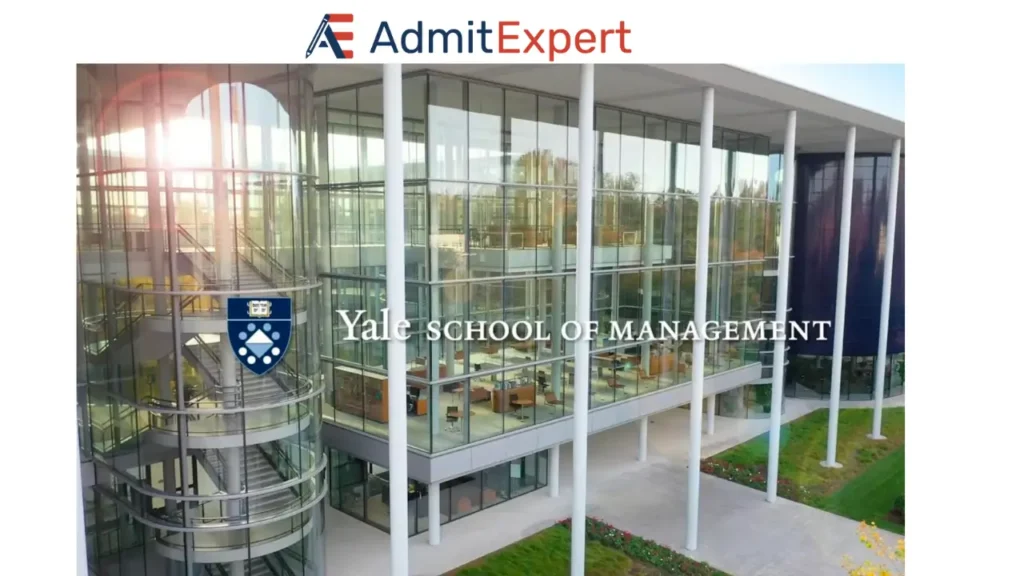
Yale SOM MBA at a Glance
| Metric | Latest official figure |
|---|---|
| Latest complete class profile | MBA Class of 2027 |
| Students enrolled | 367 |
| Women | 44% |
| International students | 41% |
| Countries represented | 47 |
| Average work experience | 5 years |
| Median undergraduate GPA | 3.69 |
| Median current GMAT | 675 |
| Median legacy GMAT | 740 |
| Median GRE | 163 Verbal / 166 Quantitative |
| MBA format | Full-time, two-year |
| STEM designation | Entire MBA is STEM-eligible |
| Class of 2025 median base salary | $175,000 |
| Job seekers receiving an offer within 3 months | 82.1% |
| Job seekers accepting an offer within 3 months | 79.9% |
| 2026–27 tuition | $90,900 |
| 2026–27 single-student cost of attendance | $128,976 |
| MBA students receiving scholarships | 66% |
| Median scholarship award shown for Class of 2027 | $65,000 |
Yale's current MBA class profile covers the Class of 2027. A September 2026 first look at the Class of 2028 confirms that the newer cohort has arrived, but Yale has not yet published its complete class statistics.
That is why this guide uses the Class of 2027 for admissions-profile benchmarks while using newer 2026–27 information for curriculum, deadlines, and costs.
What Makes the Yale MBA Curriculum Different?
Yale's curriculum is built around a simple idea:
Managers make better decisions when they understand the perspectives of the people and institutions affected by those decisions.
Rather than treating finance, marketing, operations, strategy, organizational behavior, and public policy as completely separate silos, the first-year curriculum deliberately reconnects them.
The current integrated curriculum has three important layers:
- foundational management tools;
- stakeholder-based organizational perspectives;
- a capstone course that asks students to think like senior executives.
That structure is one of the clearest reasons to choose Yale SOM rather than treating all general-management MBAs as academically interchangeable.
The First-Year Core Starts with Management Foundations
The first part of Yale's Year 1 core builds the tools students need across management disciplines.
Courses include areas such as:
- Managing Groups and Teams
- Basics of Accounting
- Probability Modeling and Statistics
- Basics of Economics
- Introduction to Negotiation
- Global Virtual Teams
- AI Foundations for Managers
These courses give students a common language in:
- quantitative analysis;
- economics;
- accounting;
- teamwork;
- negotiation;
- communication;
- and technology.
This foundation matters because MBA students arrive with very different strengths.
A consultant may be strong at structured problem solving but weaker in operating execution.
An engineer may be comfortable with technical analysis but need greater exposure to accounting, markets, and organizational behavior.
A finance professional may understand capital allocation while needing deeper customer, operations, or people-management experience.
The core gives those students a shared starting point before they specialize.
Yale Organizes the Core Around Stakeholders
The second layer of the curriculum is what makes Yale especially distinctive.
Instead of organizing every class around a traditional business-school department, Yale uses courses built around the perspectives of stakeholders and organizational systems.
Current core courses include:
- Competitor
- Customer
- Investor
- Sourcing and Managing Funds
- State and Society
- Workforce
- Innovator
- Operations Engine
- The Global Macroeconomy
The sequence culminates in The Executive, which asks students to integrate what they have learned and think from the perspective of a senior organizational leader.
Why the stakeholder model matters
Consider a company introducing an AI-enabled healthcare product.
That is not only:
- a technology problem;
- a marketing problem;
- or a finance problem.
It can simultaneously involve:
- patient needs;
- regulators;
- clinicians;
- investors;
- employees;
- privacy;
- reimbursement;
- operations;
- competitors;
- and social consequences.
Yale's curriculum is designed around that kind of interconnected decision.
For an applicant, the useful fit argument is not simply:
"I like interdisciplinary learning."
It is:
"The problems I want to solve require me to understand several stakeholder perspectives at once, and I need a curriculum that forces me to integrate them."
AI Foundations for Managers Is Now Required
For the 2026–27 academic year, Yale added AI Foundations for Managers to the required core.
The course is practical rather than purely conceptual.
Yale's AI curriculum announcement explains that students learn to work with AI tools and systems in ways relevant to managerial decision-making.
The current curriculum describes work such as:
- structuring messy data;
- grounding outputs in sources;
- building useful AI-backed applications;
- evaluating uncertainty;
- considering security and cost;
- and deciding when AI should refuse to answer.
AI is also being incorporated into later core courses and electives.
That is a meaningful update because Yale is treating AI as part of general management literacy, not only as a specialist topic for technologists.
Yale's "Raw Cases" Mimic Messy Real-World Decisions
Yale SOM uses conventional cases, but it is particularly known for its online raw cases.
A raw case can contain:
- interviews;
- reports;
- videos;
- spreadsheets;
- photographs;
- company documents;
- news coverage;
- data;
- conflicting perspectives.
The information is intentionally less tidy than a conventional 10- or 15-page case narrative.
Students have to decide:
- what matters;
- which source is credible;
- how the facts connect;
- what information is missing;
- and what decision can reasonably be made.
That is especially relevant in The Executive, where Yale uses interdisciplinary cases requiring students to synthesize multiple perspectives.
For applicants who prefer problems with one clearly defined answer, this can be challenging.
For applicants who want to become more comfortable making decisions with incomplete and contradictory information, it can be a strong fit.
The Second Year Is Highly Flexible Across Yale University
The second year is primarily elective.
Yale says 75% of SOM students take at least one course in another Yale department or school.
Students can combine SOM electives with coursework from areas such as:
- Yale Law School;
- Jackson School of Global Affairs;
- Yale School of the Environment;
- Computer Science;
- Economics;
- Statistics and Data Science;
- Psychology;
- languages;
- other Yale departments.
The current second-year electives page includes examples ranging from machine learning and AI regulation to renewable-energy finance, public leadership, graphic design, psychology, and advanced language study.
This is one of Yale's strongest forms of academic flexibility.
The useful question is not:
"What can I take elsewhere at Yale?"
It is:
"Which capability do I need that SOM alone may not develop as deeply?"
A cross-Yale course becomes valuable when it strengthens a coherent career or leadership plan.
Global Study Is a Graduation Requirement
Every Yale SOM MBA student must complete an approved global study experience.
Options currently include:
- International Experience;
- Global Network Week;
- Small Network Online Course;
- Global Social Entrepreneurship programs;
- International Exchange.
The International Experience combines classroom preparation with a roughly 10-day trip in which students engage with organizations and leaders in another market.
Global Network Week allows students to study at one of the business schools in Yale's Global Network for Advanced Management.
Global study is not simply optional travel
Because global study is required, applicants should think about what they want to learn from another market.
A useful objective might involve:
- regulation;
- consumer behavior;
- supply chains;
- institutional differences;
- political economy;
- sustainability;
- emerging-market growth.
The destination is secondary to the learning problem.
Yale also provides some support through its Global Studies Account, although students can still face travel and personal costs depending on the chosen option.
The Entire Yale SOM MBA Is Now STEM-Eligible
This is an important change from older Yale SOM information.
Since the Class of 2026, Yale has designated the entire MBA degree as STEM-eligible.
The school's STEM designation announcement explains that the designation reflects the quantitative content embedded in the required curriculum.
Eligible international students may therefore qualify to apply for the additional 24-month STEM OPT extension after standard post-completion OPT, subject to current U.S. immigration rules and individual eligibility.
The optional Management Science major still exists
Yale also offers an optional Management Science major.
That major provides deeper quantitative coursework, but international MBA students no longer need to rely on the optional major simply to obtain a STEM-designated MBA degree.
The distinction is useful:
- MBA degree: STEM-eligible
- Management Science major: optional quantitative specialization
Yale SOM MBA Class Profile 2027
Yale's current complete profile contains 367 students.
Class Composition
| Metric | Class of 2027 |
|---|---|
| Total enrollment | 367 |
| Women | 44% |
| International students | 41% |
| Countries represented | 47 |
| First-generation college students | 17% |
| Students with previous graduate degrees | 17% |
| Joint-degree students | 23 |
| U.S. military veterans | 19 |
| Average work experience | 5 years |
| Undergraduate institutions represented | 208 |
The Class of 2027 introduction also notes that students came from more than 274 previous employers.
That is a useful measure of professional diversity in a class of 367.
Yale's Class Is International—but Post-MBA Employment Is Mostly U.S.-Based
International students represent 41% of the incoming class.
That creates substantial international representation in the classroom.
It does not mean 41% of graduates take jobs outside the United States.
The Class of 2025 employment report shows 92.4% of reported employment in the United States.
International enrollment and international employment are different measures and should not be compared as though they describe the same thing.
Yale SOM GMAT, GRE, and GPA
The Class of 2027 reports:
| Academic metric | Class of 2027 |
|---|---|
| Median undergraduate GPA | 3.69 |
| Median current GMAT | 675 |
| Median legacy GMAT | 740 |
| Median GRE Verbal | 163 |
| Median GRE Quantitative | 166 |
| Students submitting GRE | 47% |
These are medians, not averages.
That distinction matters when comparing schools.
A median describes the midpoint of the class distribution. It does not indicate the minimum score required for admission.
Current GMAT and Legacy GMAT Use Different Scales
The 675 current GMAT median and 740 legacy GMAT median come from different versions of the exam.
They should not be numerically compared as though the class's performance fell by 65 points.
Older advice such as:
"You need a 740 GMAT for Yale"
refers to the legacy exam.
Applicants taking the current GMAT should benchmark themselves against current-format scores and percentiles.
Yale Does Not Publish a GMAT or GRE Minimum
Yale's current MBA admissions FAQ states that there is no minimum GMAT or GRE score.
The class medians are therefore context, not cutoffs.
The useful question is:
Does my complete academic record make a convincing case that I can handle the Yale SOM curriculum?
That includes:
- undergraduate performance;
- quantitative coursework;
- standardized test;
- analytical responsibilities at work;
- later coursework or certifications;
- context around weaker academic periods.
A test score is one piece of academic evidence.
It does not replace professional impact or a coherent reason for pursuing the MBA.
Yale Normally Requires the GMAT or GRE—and Does Not Offer Waivers
Unlike some peer schools, Yale SOM does not offer a general test waiver for MBA applicants.
The school requires a verified standardized test score.
The standard routes are:
- GMAT;
- GRE.
Yale also states that candidates who have considered or are considering law school may be able to submit the LSAT, after contacting MBA Admissions for instructions.
The Executive Assessment is not presented as a standard testing route for the full-time MBA.
What Does the Class Profile Say About Yale's Mission?
One misconception about Yale SOM is that its business-and-society mission means the class is primarily drawn from nonprofit or public-sector careers.
The Class of 2027 data does not support that interpretation.
Yale reports approximately:
- 80% from the private sector
- 20% from nonprofit or public-sector work
The professional mix includes employers across:
- consulting;
- finance;
- technology;
- healthcare;
- government;
- education;
- nonprofits;
- consumer businesses;
- media;
- international institutions.
The mission is therefore better understood as how Yale wants students to think about leadership, not as a requirement to work outside commercial business.
Five Years of Work Experience Is a Benchmark, Not a Requirement
The Class of 2027 averages five years of work experience.
That describes the cohort.
It does not establish an admissions minimum.
Applicants should focus on the substance of their experience:
- responsibility;
- progression;
- impact;
- decisions;
- leadership;
- learning;
- career clarity.
The admissions committee explicitly says it is interested in the thinking and exploration behind an applicant's career interests, rather than demanding a perfectly fixed career plan.
Yale SOM MBA Application Requirements 2026–27
The current MBA application guide includes:
- transcripts from every college or university attended;
- GMAT or GRE;
- two professional recommendations;
- resume;
- one required essay chosen from three prompts;
- application fee;
- Behavioral Assessment;
- two video questions;
- interview if invited.
The Behavioral Assessment and video questions are completed after the main application is submitted and the fee is paid.
Yale's Application Fee Uses a Sliding Scale
The standard application fee is $250.
Yale currently reduces that fee based on annual compensation:
| Applicant annual compensation | Application fee |
|---|---|
| $50,000 or more | $250 |
| Below $50,000 | $175 |
| Below $25,000 | $125 |
Yale also offers full fee waivers for several eligible groups.
Applicants requesting a waiver should do so at least 48 hours before the application deadline.
This matters because the cost of applying is not identical for every candidate.
Yale Requires Two Professional Recommendations
Yale requires two professional recommendations for regular MBA applicants.
The school strongly recommends that one come from the current supervisor where possible.
The most important criterion is not title.
Yale says recommenders should be people who:
- know the applicant's work well;
- can provide substantive examples;
- are generally senior to the applicant.
A famous executive who barely knows your work is less useful than a direct manager who can explain:
- how you perform;
- how you lead;
- how you collaborate;
- what feedback you received;
- and how you developed.
Silver Scholars follow a slightly different recommendation structure because they are applying directly from academic study.
The Yale SOM Essay: One Essay, Three Choices
Applicants choose one of three current essay prompts.
The maximum is 500 words.
The options ask applicants to write about:
- the biggest commitment they have made;
- the community that has been most meaningful to them;
- the most significant challenge they have faced.
The common thread is clear:
Yale wants to understand what matters to you.
This is not primarily a "Why Yale?" essay.
It is an opportunity to reveal:
- motivation;
- values;
- responsibility;
- identity;
- persistence;
- relationships;
- community;
- personal growth.
Choose the topic with the strongest evidence
The best prompt is not the one you think sounds most impressive.
It is the one that gives you the strongest opportunity to explain something meaningful that the rest of the application does not fully show.
A compelling essay usually includes:
- a specific situation;
- real choices or actions;
- consequences;
- reflection.
Abstract statements about values are much weaker without evidence.
For detailed prompt strategy, see our Yale SOM MBA essay analysis.
The Behavioral Assessment Adds a Non-Cognitive Academic Signal
After submitting the application, candidates complete Yale's Behavioral Assessment.
The current application guide describes it as:
- administered online by ETS;
- approximately 25 minutes;
- 130 pairs of statements;
- adaptive;
- designed to measure interpersonal and intrapersonal competencies associated with academic performance.
It is not another GMAT-style cognitive exam.
Yale uses it alongside traditional academic measures, including as a potential counterpoint to the academic record.
No specialized preparation is required.
The best strategy is not to try to reverse-engineer "correct" personality answers.
It is to respond honestly and consistently.
Yale Uses Two 60-Second Video Questions
Applicants also complete two prerecorded video questions after submitting the application.
For each question:
- Yale provides a recorded prompt;
- the applicant has 60 seconds to respond.
The questions resemble typical interview questions and are designed to help Yale assess:
- communication;
- English-language ability;
- spontaneous expression.
Yale explicitly warns applicants against reading from AI-generated scripts or relying heavily on notes.
That fits the purpose of the exercise.
The video should reveal the applicant—not the applicant's editing process.
Yale SOM Interviews Are Blind and Behavioral
Interviews are invitation-only and required before admission.
The current process uses a 30-minute interview conducted by:
- a current second-year MBA student;
- a recent alumnus;
- or an Admissions Committee member.
The interview is blind.
The interviewer sees the applicant's resume but does not review the rest of the application beforehand.
Questions are largely behavioral and also cover:
- MBA motivation;
- post-MBA goals.
That means the applicant needs to make the professional story understandable from the beginning.
Prepare examples involving:
- leadership;
- conflict;
- collaboration;
- difficult decisions;
- failure;
- impact;
- feedback;
- career transitions.
Know the stories.
Do not memorize speeches.
Yale SOM MBA Application Deadlines 2026–27
| Round | Application deadline | Decision release |
|---|---|---|
| Round 1 | September 15, 2026 | December 3, 2026 |
| Round 2 | January 6, 2027 | March 18, 2027 |
| Round 3 | April 7, 2027 | May 13, 2027 |
As of September 28, 2026, Round 1 has passed.
The next regular deadline is:
Round 2 — January 6, 2027
Yale publishes the current dates on its MBA application information page.
Is Round 2 too late?
No.
Round 2 is a standard admissions round.
Additional preparation time can be valuable if it materially improves:
- test score;
- essay;
- recommendation quality;
- career exploration;
- school research.
Round 3 is more constrained because admission and scholarship decisions depend on remaining space and funding.
Silver Scholars Is Not a Conventional Deferred MBA
Yale's Silver Scholars Program allows eligible college seniors and certain graduate students to begin the MBA immediately after completing their current academic program.
The structure is unusual:
- complete the first-year MBA core;
- work full time for one or more years;
- return to Yale for the elective year.
That differs from deferred programs where applicants first work for several years and then begin both MBA years consecutively.
Why the structure matters
Silver Scholars gain the MBA core before their main professional experience.
That can be useful for students who want business fundamentals before entering the workforce.
It also means recruiting and career development follow a different sequence from the standard MBA.
Eligible candidates may apply in any of Yale's three application rounds.
Yale MBA Employment Report: Class of 2025
The current Yale SOM employment report covers 336 MBA graduates in the Class of 2025.
Employment Status
| Outcome | Class of 2025 |
|---|---|
| Class size | 336 |
| Seeking employment | 274 |
| Share seeking employment | 81.5% |
| Offer within 3 months | 82.1% of seekers |
| Accepted within 3 months | 79.9% of seekers |
| Starting own business | 22 graduates / 6.5% |
| Company sponsored | 18 graduates / 5.4% |
| Postponing search | 9 graduates / 2.7% |
| Continuing education | 3 graduates / 0.9% |
The denominator matters.
The 82.1% offer rate applies to students seeking employment, not the entire graduating class.
Similarly, the 79.9% acceptance rate measures students who accepted a role within the reporting window.
Students who were starting businesses, returning to sponsors, or continuing education belong to different categories.
Yale's 2025 Hiring Market Required More Patience
Yale's own 2025 career analysis notes that employers increasingly hired closer to actual staffing needs rather than following only traditional on-campus timelines.
That contributed to longer job searches.
This is useful context for interpreting the three-month employment rate.
A search continuing beyond graduation is not automatically evidence that a candidate has no options. But applicants financing an MBA should still plan for the possibility that recruiting may take longer than expected.
That means maintaining:
- adequate financial runway;
- a broader employer list;
- geographic flexibility;
- and realistic backup paths.
Yale MBA Salary
| Compensation metric | Class of 2025 |
|---|---|
| 25th percentile base salary | $140,000 |
| Median base salary | $175,000 |
| 75th percentile base salary | $190,000 |
| Median signing bonus | $30,000 |
| Median guaranteed year-end bonus | $40,000 |
Compensation information is self-reported.
Of students reporting accepted offers, 91.8% included salary information.
Among salary reporters:
- 71.1% reported a signing bonus;
- 5.5% reported a guaranteed year-end bonus.
That is why the salary and bonus medians should not be added together and presented as median total compensation.
They describe different reporting populations.
Employment by Industry
| Industry | Share of reported hires | Median base salary |
|---|---|---|
| Consulting Services | 36.7% | $190,000 |
| Financial Services | 28.9% | $175,000 |
| Technology | 8.3% | $138,200 |
| Healthcare / Pharmaceuticals | 5.0% | $140,000 |
| Retail | 4.6% | $143,900 |
| Energy | 3.7% | $155,000 |
| Nonprofit | 2.8% | Not disclosed |
| Consumer Packaged Goods | 2.3% | $127,000 |
| Transportation | 2.3% | $150,000 |
Consulting and finance together account for 65.6% of reported hires.
Adding technology brings the top three industries to 73.9%.
That concentration is important.
Yale supports many career paths, but the current employment market is not evenly distributed across all sectors.
Yale's Mission Does Not Mean Most Graduates Work in Nonprofits
This is one of the most important conclusions from the employment data.
Nonprofit employers account for 2.8% of reported industry placements.
Consulting, finance, technology, healthcare, retail, energy, and other commercial sectors account for the large majority.
Yale's "business and society" mission is therefore better understood as:
a framework for thinking about leadership and impact across sectors
rather than:
a requirement to choose nonprofit or public-sector employment.
A consultant working on healthcare access, an investor financing climate technology, or a consumer executive changing supply-chain practices can all engage with business-and-society questions inside commercial organizations.
Finance at Yale SOM: Investment Banking Dominates the Category
The 28.9% finance total contains several very different career markets.
| Finance sub-industry | Share of all reported hires | Median base salary |
|---|---|---|
| Investment Banking | 17.9% | $175,000 |
| Diversified Financial Services | 4.1% | $130,000 |
| Investment Management | 3.7% | $140,000 |
| Venture Capital | 1.8% | Not disclosed |
| Private Equity | 1.4% | Not disclosed |
Investment banking represents well over half of the finance placements.
That distinction matters for applicants.
Banking has a comparatively structured MBA internship and full-time recruiting process.
Private equity and venture capital are much smaller categories and often place more weight on:
- prior transaction experience;
- investing experience;
- sector expertise;
- independent networking.
"Finance" is therefore too broad a career goal for evaluating program fit.
Consulting Is Yale's Largest Industry Destination
Consulting represents 36.7% of reported industry placements and carries a median base salary of $190,000.
The sector includes:
- large strategy firms;
- healthcare consulting;
- public-sector consulting;
- nonprofit consulting;
- other specialized advisory work.
For a career changer, consulting can be attractive because the recruiting process is comparatively structured and values broad problem-solving and communication skills.
But the current hiring environment also reinforces the importance of:
- office selection;
- internship recruiting;
- networking;
- case preparation;
- backup options.
Technology Is a Smaller but Meaningful Pipeline
Technology represents 8.3% of reported industry placements, with a median base salary of $138,200.
That is materially smaller than consulting or finance.
Applicants targeting technology should therefore investigate the function, not only the industry.
A technology company may hire MBAs into:
- product;
- strategy;
- finance;
- operations;
- marketing;
- business development.
The employment report tells you the sector.
It does not automatically tell you the accessibility of the role you want.
Employment by Function
| Function | Share of reported hires |
|---|---|
| Consulting / Strategy | 48.4% |
| Finance / Accounting | 29.3% |
| Marketing / Sales | 9.8% |
| General Management | 6.0% |
| Information Technology | 2.8% |
| Operations / Logistics | 1.4% |
The consulting-function figure is much larger than the consulting-industry figure because Yale combines:
- 36.7% external consulting
- 11.6% internal consulting / strategy
This is a good example of why industry and function should never be treated as interchangeable.
A graduate working in corporate strategy for a healthcare company:
- belongs to healthcare by industry;
- but strategy by function.
For career planning, specify:
Function + industry + geography
rather than one broad label.
Where Yale SOM Graduates Work
| Region | Share of reported employment |
|---|---|
| United States | 92.4% |
| International | 7.6% |
Among U.S. placements:
| U.S. region | Share of U.S. hires |
|---|---|
| Northeast | 57.7% |
| West | 17.5% |
| Midwest | 6.7% |
| Southwest | 6.7% |
| South | 6.2% |
| Mid-Atlantic | 5.2% |
The Northeast is clearly Yale's strongest geographic market.
That is unsurprising given New Haven's access to:
- New York;
- Boston;
- East Coast finance;
- consulting;
- healthcare;
- technology.
But the West also represents a meaningful share of placements.
International applicants should note that a 41% international entering class does not translate into a similarly international employment distribution.
The job market is heavily U.S.-oriented.
Entrepreneurship Is Visible but Not the Dominant Path
Yale reports 22 Class of 2025 graduates starting their own ventures, equal to 6.5% of the class.
That is meaningful without being as large as the entrepreneurship share at some other top MBA programs.
Yale also supports entrepreneurship through:
- electives;
- the broader Yale entrepreneurial ecosystem;
- summer support;
- an Entrepreneurial Fellowship.
For founders, the financial calculation differs from salaried employment.
The $175,000 median salary should not be used as expected founder income.
Yale SOM Cost of Attendance 2026–27
Yale's current cost information gives the following annual budget for a single MBA student:
| Expense | 2026–27 amount |
|---|---|
| Tuition | $90,900 |
| Program fee | $500 |
| Housing, food, and utilities | $22,991 |
| Personal expenses | $5,525 |
| Transportation | $3,856 |
| Books and course materials | $1,440 |
| Health insurance | $3,764 |
| Total | $128,976 |
The budget assumes:
- a single student;
- a modest lifestyle;
- shared housing.
Students with qualifying alternative hospitalization insurance may waive the Yale health-insurance charge.
$128,976 Is a One-Year Budget, Not the MBA's Total Cost
The published cost covers one academic year.
It should not be doubled and presented as the exact two-year price because:
- next year's tuition can change;
- living costs can change;
- global-study costs vary;
- personal spending varies;
- financing costs depend on borrowing.
A realistic MBA budget should include:
- current first-year cost;
- estimated second-year inflation;
- confirmed scholarship support;
- internship income;
- financing cost;
- global-study travel;
- foregone salary.
Opportunity Cost Matters
An MBA requires two years away from full-time employment for the standard Yale pathway.
That means the economic cost includes the income and career progression an applicant gives up.
For someone already earning a high salary in:
- consulting;
- investment banking;
- technology;
- healthcare;
- or another professional field,
foregone compensation can be one of the largest components of the MBA investment.
A salary-versus-tuition comparison is therefore incomplete.
Yale SOM Scholarships: The Process Changed
Yale SOM now requires admitted MBA candidates to complete a short supplemental scholarship application to be considered for Yale SOM grant aid.
This is important because older descriptions saying scholarship consideration is automatic are no longer correct for the general scholarship process.
The current scholarship page says:
- scholarships are awarded after admission;
- only candidates who complete the supplemental application are considered for general grant aid;
- decisions are driven largely by candidate merit but informed by personal circumstances and potential contribution;
- most scholarships are awarded for both MBA years unless stated otherwise.
The admissions decision and scholarship decision are therefore related but distinct.
How Much Scholarship Support Does Yale Provide?
Yale's current Affording Your MBA page reports:
| Scholarship metric | Current figure |
|---|---|
| MBA students receiving scholarships | 66% |
| Median scholarship award shown for Class of 2027 | $65,000 |
| Grant aid awarded to incoming MBA students in 2024 | More than $7.8 million |
The $65,000 figure is Yale's published median scholarship award for the Class of 2027.
Applicants should not assume they will receive that amount.
Scholarship outcomes depend on the individual application and supplemental scholarship process.
Dean's Scholarships Make Up Much of Yale's General Funding
Dean's Scholarships are the bulk of Yale SOM's scholarship grants.
They are awarded for anticipated contribution to the class and may later be associated with a donor-funded scholarship name.
The key point for applicants is that a named scholarship does not necessarily mean new money is being added on top of an existing award.
The actual scholarship offer—not the name—is what should drive the financial comparison.
Aspire Fellowships Can Be Very Large
Yale launched the Aspire Fellowship for students who have overcome significant socioeconomic challenges.
The school committed more than $5 million to the initiative, with individual awards ranging from:
$60,000 to full tuition and fees
The fellowship process occurs after admission.
That makes socioeconomic context relevant to the scholarship process even though Yale describes its general award process as primarily merit-driven.
Some Scholarships Have Their Own Eligibility Rules
Yale also lists specific scholarships and fellowships for eligible groups and career paths.
Examples include:
- Consortium Fellowships;
- Forté Fellowships;
- Yale Scholarships for Entrepreneurs;
- Yale Africa Impact Scholarships;
- Global Leaders from India MBA Scholarships;
- Yale-FUNED support for eligible Mexican students.
The Global Leaders from India MBA Scholarship, for example, provides up to five merit scholarships annually covering at least half of tuition for eligible students from India.
Different awards have different eligibility and application processes.
Do not assume one named scholarship can simply be added to another unless the official award terms allow it.
Yale's Loan Forgiveness Program Changes the Economics of Public-Interest Careers
Yale SOM's Loan Forgiveness Program supports eligible graduates working full time in qualifying:
- government organizations;
- nonprofit organizations;
- equivalent organizations outside the United States.
International graduates can also be eligible.
Support depends on:
- employment type;
- income;
- eligible educational loans;
- program rules.
Graduates can potentially participate during the first 10 years after graduation, subject to current eligibility terms.
That can make the MBA economics materially different for someone pursuing a lower-paid public-interest career.
The important caution is that Yale's public page includes some historic income thresholds and directs alumni to current program terms.
Applicants should therefore evaluate the existence and structure of the program, but not assume today's published historic thresholds will govern their future eligibility.
Yale Also Supports Entrepreneurs with Loan Deferral
Yale's current financing page describes an Entrepreneurial Fellowship that can help eligible founders defer student-loan payments for the first two years after graduation.
The school pays accruing interest up to $7,000 per year under the program.
That is economically different from a tuition scholarship.
It supports the post-MBA period when a founder may have limited income and wants to preserve startup runway.
Is Yale SOM Worth the Cost?
There is no universal answer.
The current annual cost is $128,976 before:
- second-year increases;
- financing costs;
- foregone salary.
But Yale also reports:
- 66% of MBA students receiving scholarships;
- a $65,000 median scholarship award for the Class of 2027;
- a $175,000 median base salary for the Class of 2025;
- loan-forgiveness support for qualifying public/nonprofit careers;
- entrepreneurial loan support.
The right ROI analysis therefore depends heavily on:
- scholarship offer;
- target career;
- debt required;
- opportunity cost;
- post-MBA geography;
- long-term goals.
Is Yale SOM a Good MBA for Consulting?
Yes.
Consulting is the largest Class of 2025 industry destination at 36.7%.
Consulting and internal strategy together account for 48.4% of job functions.
The median external-consulting base salary is $190,000.
For career changers, consulting also offers a relatively structured internship and full-time recruiting pathway.
Applicants should still investigate:
- target offices;
- visa sponsorship;
- case preparation;
- internship conversion;
- firm-specific hiring.
Is Yale SOM a Good MBA for Finance?
Financial services represents 28.9% of reported industry placements.
Investment banking is particularly prominent at 17.9% of all reported hires.
Investment management, diversified financial services, private equity, and venture capital make up smaller parts of the category.
That means Yale has a substantial finance pipeline, but applicants should distinguish structured banking recruitment from smaller, more experience-dependent investing markets.
Is Yale SOM a Good MBA for Technology?
Technology accounts for 8.3% of Class of 2025 industry placements.
That is a meaningful pipeline, but much smaller than consulting and finance.
Applicants interested in technology should therefore investigate:
- the exact function;
- employer list;
- internship route;
- alumni;
- geography.
"Technology" alone is not specific enough to judge whether Yale is the right career platform.
Is Yale SOM a Good MBA for Social Impact?
Yale's curriculum and mission are unusually relevant to applicants interested in:
- government;
- nonprofit leadership;
- social enterprise;
- impact investing;
- sustainability;
- public-private problems.
But "social impact" at Yale should not be understood as one narrow employment category.
The Class of 2025 employment data shows only a small share of graduates entering nonprofit employers directly.
Impact can also sit inside:
- consulting;
- finance;
- technology;
- healthcare;
- energy;
- entrepreneurship.
The relevant question is what kind of impact role you actually want.
Who Should Consider Yale SOM Most Seriously?
Yale deserves close consideration if you value:
- an integrated rather than siloed first-year curriculum;
- stakeholder-oriented decision-making;
- raw cases;
- required AI management training;
- a STEM-designated MBA;
- extensive access to the wider Yale University curriculum;
- required global study;
- consulting and finance recruiting;
- strong scholarship availability;
- loan forgiveness for eligible public-interest careers;
- a relatively small class;
- and a school mission that treats business decisions in a broader societal context.
Applicants should think more carefully if they prefer:
- a purely functional first-year curriculum;
- a much larger MBA cohort;
- a program defined primarily by one commercial specialty;
- or a school where cross-sector questions play a smaller role in the classroom.
How to Decide Whether Yale SOM Fits Your MBA Goals
1. Define the role you want
Specify:
- function;
- industry;
- geography;
- employer type.
2. Identify the problem you need the MBA to solve
Is the gap:
- management breadth;
- analytical skill;
- leadership;
- stakeholder judgment;
- recruiting access;
- network;
- industry credibility;
- cross-sector knowledge?
3. Build a Yale learning path
Connect those gaps to:
- integrated core;
- AI Foundations;
- raw cases;
- electives;
- cross-Yale courses;
- global study;
- internship;
- clubs and centers.
4. Test the career data precisely
Do not use the 28.9% finance figure to justify a private-equity goal.
Do not use the 8.3% technology figure to justify a product-management goal.
Look at the specific path.
5. Compare net economics
Include:
- cost of attendance;
- confirmed scholarship;
- loans;
- internship income;
- loan-forgiveness eligibility where relevant;
- opportunity cost.
Yale SOM MBA FAQs
What is Yale SOM's latest complete MBA class profile?
The Class of 2027 remains Yale SOM's latest complete official profile. Yale has welcomed the Class of 2028 but has said its full profile is still being finalized.
How many students are in the Yale SOM MBA Class of 2027?
The class contains 367 students.
What is the median GMAT at Yale SOM?
The Class of 2027 reports a 675 median current GMAT and a 740 median legacy GMAT. The two test versions use different scales and should not be compared directly.
What is the median GRE at Yale SOM?
The current class reports 163 Verbal and 166 Quantitative.
What is the median GPA at Yale SOM?
The Class of 2027 reports a 3.69 median undergraduate GPA for applicable U.S. institutions using a 4.0 scale.
How much work experience do Yale SOM MBA students have?
The current class averages five years of work experience.
Does Yale SOM offer GMAT or GRE waivers?
No. Yale SOM does not offer a general test waiver for MBA applicants.
Does Yale SOM accept the LSAT?
Yale states that candidates who have considered or are considering law school may be able to submit the LSAT after contacting MBA Admissions for instructions. GMAT and GRE remain the standard MBA testing routes.
How many recommendations does Yale SOM require?
Regular MBA applicants submit two professional recommendations.
What is the Yale SOM MBA essay?
Applicants choose one of three prompts—commitment, community, or challenge—and submit one essay of up to 500 words.
What is Yale's Behavioral Assessment?
It is an approximately 25-minute adaptive online assessment administered by ETS. Applicants respond to 130 pairs of statements measuring non-cognitive interpersonal and intrapersonal competencies.
How many video questions are in the Yale MBA application?
Applicants complete two prerecorded video questions, with up to 60 seconds for each response.
How long is the Yale SOM interview?
The invitation-only interview lasts approximately 30 minutes and is blind: the interviewer sees the resume but not the full application.
What is the next Yale SOM MBA deadline?
As of September 28, 2026, the next deadline is Round 2 on January 6, 2027.
Is Yale SOM STEM-designated?
Yes. The entire Yale SOM MBA is STEM-eligible. This designation took effect with the Class of 2026.
How much does Yale SOM cost?
For 2026–27, tuition is $90,900, and the published single-student cost of attendance is $128,976 for one academic year.
Are Yale SOM scholarships automatic?
No. Admitted candidates must complete Yale SOM's supplemental scholarship application to be considered for general school grant aid.
How many Yale MBA students receive scholarships?
Yale reports that 66% of MBA students receive scholarships.
What is Yale SOM's median scholarship award?
Yale currently shows a $65,000 median scholarship award for the Class of 2027.
Is Yale SOM mainly a nonprofit MBA?
No. Approximately 80% of the current entering class came from the private sector, and consulting and finance dominate the Class of 2025 employment report.
How many Yale MBA graduates start companies?
Yale reports 22 Class of 2025 graduates, or 6.5% of the class, starting their own businesses.
Final Thoughts
Yale SOM is easiest to misunderstand when its mission is treated as a career category.
"Business and society" does not mean choosing between commercial success and public impact.
The curriculum is designed around the idea that senior leaders increasingly have to understand both.
The first-year core integrates the perspectives of:
- customers;
- investors;
- employees;
- competitors;
- governments;
- society.
Raw cases force students to sort through messy information.
AI is now a required management subject.
Global study is mandatory.
The second year opens into the broader Yale University curriculum.
And the entire MBA is now STEM-eligible.
The career data is equally important.
Most graduates do not enter nonprofits. Consulting and finance dominate the employment market, with technology, healthcare, retail, energy, and other sectors also represented.
That is precisely why Yale's mission should be viewed as a leadership framework rather than a sector constraint.
The strongest reason to apply is not:
"I want to make an impact."
It is:
"The decisions I want to make in my career require me to understand organizations from several perspectives at once, and Yale's integrated curriculum, university access, global experience, career ecosystem, and financial support give me an unusually strong way to develop that capability."
If Yale SOM is on your target list, continue with our Yale SOM MBA essay guide and MBA application deadlines tracker.
Related Articles

Deferred MBA Programs: 2027 Deadlines, Eligibility & Top Schools
Compare the leading deferred MBA programs for college seniors and eligible graduate students, including HBS 2+2, Stanford, Wharton, Booth, Kellogg, MIT Sloan, Columbia, Haas and Darden, with current 2027 deadlines and rules.
Read Article →
M7 Business Schools: 2026–2027 Guide to Rankings, Admissions, Costs & Careers
A current comparison of Harvard, Stanford, Wharton, Chicago Booth, Kellogg, MIT Sloan and Columbia covering 2026 rankings, Class of 2027 profiles, GMAT/GRE scores, 2027 application deadlines, MBA costs and Class of 2025 career outcomes.
Read Article →
Stanford GSB MBA Guide 2026–27: Admissions, Class Profile, Curriculum, Employment, Fees & Scholarships
A complete guide to the Stanford Graduate School of Business MBA covering admissions, the latest class profile, GMAT and GRE scores, curriculum, application deadlines, employment outcomes, tuition, cost of attendance, scholarships, and financial aid.
Read Article →